Understanding revenue growth is crucial for any business, regardless of size. It’s not just about the numbers; it’s a reflection of your company’s health, market position, and strategic effectiveness. This guide will equip you with the knowledge and tools to accurately calculate revenue growth, from basic year-over-year comparisons to more sophisticated methods like Compound Annual Growth Rate (CAGR). We’ll explore different types of growth, identify key influencing factors, and demonstrate how to interpret trends to make informed business decisions.
We’ll delve into both simple and advanced calculation methods, providing clear examples and step-by-step instructions. Whether you’re a small business owner tracking your progress or a financial analyst assessing investment opportunities, this comprehensive guide will provide the insights you need to effectively analyze and utilize revenue growth data.
Calculating Revenue Growth
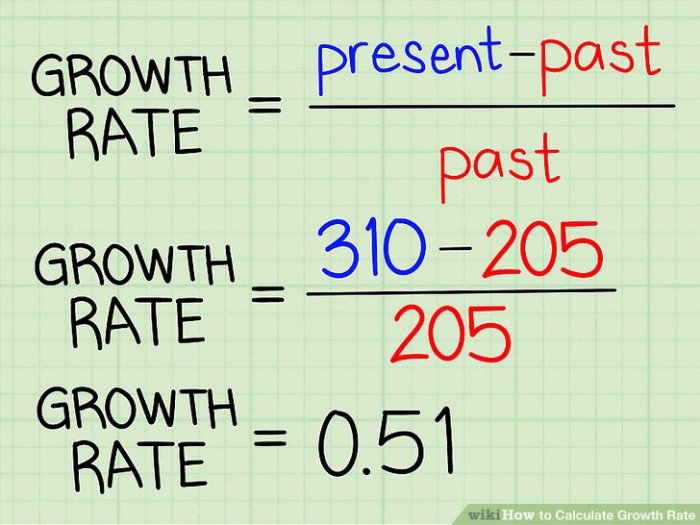
Understanding revenue growth is crucial for assessing a business’s financial health and future prospects. This section details fundamental methods for calculating revenue growth, focusing on year-over-year comparisons and multi-year analyses. Accurate revenue growth calculation provides valuable insights for strategic decision-making.
Year-Over-Year Revenue Growth Calculation
The year-over-year (YoY) method compares revenue from one year to the revenue from the previous year. This provides a clear picture of the immediate growth or decline. The formula for calculating YoY growth is straightforward and widely used.
| Year | Revenue | YoY Growth Percentage | Growth Type |
|---|---|---|---|
| 2021 | $100,000 | – | – |
| 2022 | $120,000 | 20% | Organic |
| 2023 | $150,000 | 25% | Organic |
| 2024 | $180,000 | 20% | Organic |
The YoY growth percentage is calculated using the following formula: [(Current Year Revenue - Previous Year Revenue) / Previous Year Revenue]
100. For example, the 20% growth in 2022 is calculated as
[($120,000 - $100,000) / $100,000]100 = 20%. The “Growth Type” column indicates whether the growth is organic (from core business activities) or inorganic (from acquisitions or other non-core activities).
Multi-Year Revenue Growth Calculation
Analyzing revenue growth over multiple years provides a more comprehensive understanding of long-term trends. This calculation involves comparing the revenue from the starting year to the revenue from the ending year. This method helps to identify consistent growth patterns or periods of significant change.A step-by-step guide for calculating multi-year revenue growth:
1. Identify the starting and ending years
Determine the period for which you want to calculate the growth.
2. Obtain revenue data
Gather the revenue figures for each year within the chosen period.
3. Calculate the total growth
Subtract the starting year’s revenue from the ending year’s revenue.
4. Calculate the average annual growth rate
This requires using a compound annual growth rate (CAGR) formula, which accounts for the compounding effect of growth over multiple years. The formula is: CAGR = [(Ending Value / Beginning Value)^(1 / Number of Years)]1. This provides a more accurate representation of the average annual growth than a simple average of yearly growth percentages.
Example: Three-Year Revenue Growth for a Small Business
Let’s consider a small bakery with the following revenue figures:* 2021: $50,000
2022
$60,000
2023
$75,000To calculate the multi-year growth, we use the CAGR formula:
1. Beginning Value
$50,000 (Revenue in 2021)
2. Ending Value
$75,000 (Revenue in 2023)
3. Number of Years
3 (2021-2023)Therefore, the CAGR is: [(75000 / 50000)^(1/3)]1 ≈ 0.1447 or 14.47%. This indicates that the bakery experienced an average annual revenue growth of approximately 14.47% over the three-year period. This CAGR provides a clearer picture of the business’s sustained growth than simply looking at the yearly growth percentages in isolation.
Advanced Revenue Growth Calculations
Understanding simple year-over-year revenue growth is a good start, but for a more comprehensive analysis, especially over longer periods, more sophisticated metrics are necessary. These advanced calculations provide a clearer picture of the underlying growth trajectory and allow for better forecasting.
Compound Annual Growth Rate (CAGR) Calculation and Significance
The Compound Annual Growth Rate (CAGR) represents the average annual growth rate of an investment or revenue over a specified period, assuming profits are reinvested during the term. Unlike simple year-over-year growth, CAGR smooths out fluctuations and provides a more stable representation of long-term growth. This makes it particularly useful for comparing the performance of different companies or investments over time, even if their growth patterns aren’t perfectly consistent year to year.
CAGR is a crucial metric for investors, business analysts, and executives making long-term strategic decisions.
CAGR versus Year-over-Year Growth Rate
While both CAGR and year-over-year (YoY) growth rates measure revenue increases, they serve different purposes. YoY growth shows the percentage change in revenue from one year to the next. This is a short-term indicator, highly sensitive to short-term market fluctuations and economic events. In contrast, CAGR provides a long-term perspective, averaging out the year-to-year variations. YoY growth is valuable for monitoring short-term trends and identifying immediate challenges or successes, whereas CAGR is more useful for assessing long-term performance and making strategic plans.
Using both metrics together provides a more complete picture of revenue growth.
CAGR Calculation Over Five Years
The formula for calculating CAGR is:
CAGR = [(Ending Value / Beginning Value)^(1 / Number of years)] – 1
The following table demonstrates a hypothetical example of CAGR calculation over five years:
| Year | Revenue | YoY Growth | CAGR |
|---|---|---|---|
| 2019 | $100,000 | – | – |
| 2020 | $110,000 | 10% | – |
| 2021 | $125,000 | 13.6% | – |
| 2022 | $140,000 | 12% | – |
| 2023 | $160,000 | 14.3% | 10.4% |
Note: The CAGR of 10.4% is calculated using the formula above: [(160000/100000)^(1/5)] -1. The YoY growth is calculated as (Revenue(Year N)
- Revenue(Year N-1))/Revenue(Year N-1)
- 100%. The CAGR column is left blank for years 2019-2022 to highlight that CAGR is a measure calculated across the entire period, not individually for each year.
Factors Influencing Revenue Growth
Revenue growth, while ultimately represented by a simple calculation, is a complex outcome influenced by a multitude of interconnected factors. Understanding these influences is crucial for businesses aiming to achieve sustainable and predictable growth. Analyzing both internal and external forces allows for more strategic planning and proactive adjustments to maximize revenue potential.
Internal Factors Influencing Revenue Growth
Internal factors are those directly under the control of a business. Effectively managing these elements can significantly impact the trajectory of revenue growth. A well-defined strategy addressing these aspects is essential for consistent performance.
- Pricing Strategies: Pricing models, such as value-based pricing, cost-plus pricing, or competitive pricing, directly affect revenue. A well-crafted pricing strategy balances profitability with market competitiveness and customer perception of value. For example, a company might increase prices slightly if it offers superior product features or exceptional customer service.
- Product Development and Innovation: Introducing new products or significantly improving existing ones can capture new market segments and increase sales. Continuous innovation keeps the business relevant and competitive, driving revenue growth. Consider Apple’s consistent release of new iPhone models, each generating substantial revenue.
- Sales and Marketing Effectiveness: Robust sales and marketing efforts are essential for reaching target customers and converting leads into sales. Effective strategies include targeted advertising, content marketing, and strong sales team training. A company’s marketing ROI directly impacts revenue.
- Operational Efficiency: Streamlined operations, efficient production processes, and reduced overhead costs directly contribute to higher profit margins and ultimately, increased revenue. This could involve implementing new technology or improving supply chain management.
- Customer Retention and Loyalty: Retaining existing customers is often more cost-effective than acquiring new ones. Building strong customer relationships through excellent service and loyalty programs leads to repeat business and increased revenue streams. Companies like Amazon thrive on customer retention strategies.
External Factors Influencing Revenue Growth
External factors represent the broader economic and market landscape within which a business operates. These factors are largely beyond a company’s direct control, but understanding their influence is vital for effective planning and risk mitigation.
- Market Conditions: The overall health and growth of the market significantly influence a company’s revenue. A booming market presents more opportunities, while a contracting market can severely impact sales. For instance, during economic downturns, consumer spending decreases, impacting businesses across sectors.
- Economic Trends: Macroeconomic factors such as inflation, interest rates, and unemployment rates have a profound impact on consumer spending and business investment, thus influencing revenue growth. High inflation can reduce purchasing power, affecting sales.
- Competitive Landscape: The actions and strategies of competitors directly affect market share and revenue. Intense competition can lead to price wars and reduced profit margins. The rise of streaming services like Netflix significantly impacted traditional cable TV providers.
- Technological Advancements: Technological disruptions can create new opportunities but also pose threats. Companies must adapt to technological changes to remain competitive and capitalize on new technologies. The emergence of e-commerce drastically altered retail landscapes.
- Government Regulations and Policies: Changes in tax laws, environmental regulations, or trade policies can significantly impact a company’s operations and revenue. For example, new environmental regulations could increase production costs for some industries.
Analyzing Revenue Growth Trends
Understanding revenue growth trends is crucial for businesses to make informed decisions about future strategies. Analyzing these trends involves more than just looking at the numbers; it requires interpreting the patterns and identifying underlying factors that contribute to growth or decline. Visual representations, such as line charts, are invaluable tools in this process.Interpreting Revenue Growth Using Line ChartsA line chart provides a clear visual representation of revenue growth over time.
Imagine a chart showing revenue growth over five years. The first two years display a steep upward trajectory, indicating strong and consistent growth. However, in the third year, the line begins to flatten, showing a significant decrease in the rate of growth. Years four and five reveal a continued, albeit slower, upward trend. This pattern suggests a period of high growth initially, potentially driven by factors like a new product launch or expansion into a new market.
The subsequent slowdown might be attributed to increased market competition, economic downturn, or saturation of the initial target market. The continued, albeit slower, growth in the later years indicates the company’s ability to adapt and find new avenues for growth, even in a challenging environment. The chart visually highlights the need for strategic adjustments to maintain a robust growth trajectory.Revenue Growth Patterns and Their ImplicationsSeveral distinct revenue growth patterns exist, each with its own implications.
For example, exponential growth, characterized by a consistently increasing rate of growth, is ideal but often unsustainable in the long term. Linear growth, where revenue increases at a constant rate, indicates stable performance and predictability. However, it may also suggest a lack of innovation or expansion opportunities. Conversely, cyclical growth, characterized by periods of high growth followed by periods of decline, often reflects external factors like economic cycles or seasonal variations.
Understanding these patterns allows businesses to proactively manage expectations and allocate resources effectively. For example, a company experiencing cyclical growth might adjust its marketing spend to align with peak seasons or diversify its product offerings to mitigate the impact of downturns. A company exhibiting consistently linear growth might consider investing in research and development or exploring new market segments to stimulate faster growth.Strategies for Maintaining or Improving Revenue GrowthMaintaining or improving revenue growth requires a multifaceted approach.
Businesses should continuously monitor key performance indicators (KPIs) such as customer acquisition cost, customer lifetime value, and market share. This data-driven approach allows for timely identification of potential issues and informed decision-making. Furthermore, strategic investments in research and development, marketing, and sales are crucial for innovation and market penetration. Investing in employee training and development also fosters a more productive and efficient workforce.
Finally, adapting to market changes and embracing technological advancements is essential for maintaining a competitive edge and sustaining long-term revenue growth. A company, for example, facing declining growth might invest in digital marketing strategies to reach a wider audience or develop new products to cater to evolving consumer preferences. Continuous improvement and adaptation are key to ensuring sustained revenue growth.
Revenue Growth and Business Performance
Revenue growth is a crucial indicator of a company’s overall health and future prospects, but it’s not the only factor determining success. Understanding the relationship between revenue growth and profitability, and how to leverage this data for strategic decision-making, is vital for long-term sustainability. Simply increasing revenue without considering profitability can be detrimental.Revenue growth and profitability are intrinsically linked, yet distinct, aspects of business performance.
While increased revenue signifies market expansion and product appeal, it doesn’t automatically translate to higher profits. Profitability considers the costs associated with generating that revenue. High revenue growth with low profitability might indicate inefficient operations, high marketing costs, or low pricing strategies. Conversely, slow revenue growth coupled with high profitability suggests a potentially sustainable, though perhaps less ambitious, business model.
The ideal scenario is strong, sustainable revenue growth alongside healthy profit margins.
The Interplay of Revenue Growth and Profitability
Understanding the relationship between revenue growth and profit margins is crucial for informed decision-making. A company might experience rapid revenue growth due to aggressive marketing or discounting, but this might negatively impact profit margins if the increased costs outweigh the revenue gains. Conversely, slow revenue growth might be accompanied by high profit margins if the company focuses on efficiency and premium pricing.
Analyzing both metrics together provides a holistic view of the business’s financial health. For example, a company might choose to prioritize profit margin over rapid revenue growth in a competitive market to ensure financial stability. Alternatively, a company in a high-growth market might accept lower profit margins initially to gain market share and scale operations, aiming for higher margins later.
Using Revenue Growth Data for Strategic Decision-Making
Revenue growth data is a powerful tool for informing various strategic business decisions. Analyzing revenue trends can highlight successful products or services, identify market segments with high potential, and reveal areas needing improvement. This data can guide decisions related to resource allocation, marketing strategies, product development, and expansion plans. For instance, consistent growth in a particular product line might justify investment in expanding its production capacity or developing related products.
Conversely, stagnant or declining revenue in a specific area might indicate the need for product innovation, marketing adjustments, or even market exit. A company might use revenue growth data to predict future performance and make informed decisions about investments, hiring, and expansion.
Monitoring Revenue Growth for Long-Term Sustainability
Consistent monitoring of revenue growth is essential for long-term business sustainability. It allows for proactive identification of potential problems and opportunities, enabling timely adjustments to business strategies. Analyzing revenue growth over time, considering factors like seasonality and economic cycles, provides a clearer picture of the company’s performance and its resilience to market fluctuations. Regular monitoring enables early detection of declining revenue trends, allowing for corrective actions before they significantly impact the business.
This proactive approach ensures that the company remains competitive and adaptable to changing market dynamics, contributing to its overall long-term viability.
Mastering revenue growth calculations is essential for informed decision-making and long-term business success. By understanding the various methods, interpreting trends, and considering both internal and external factors, businesses can effectively track their performance, identify areas for improvement, and ultimately achieve sustainable growth. Remember that consistent monitoring and analysis are key to leveraging revenue growth data for strategic advantage.
User Queries
What is the difference between organic and inorganic revenue growth?
Organic growth stems from internal efforts like increased sales or new product launches. Inorganic growth comes from external factors like acquisitions or mergers.
Can negative revenue growth be beneficial?
While generally undesirable, strategic downsizing or restructuring can lead to short-term negative growth but improve long-term profitability and sustainability.
How frequently should I calculate revenue growth?
The frequency depends on your business needs. Monthly or quarterly calculations are common for close monitoring, while annual calculations suffice for long-term trend analysis.
What are some limitations of using only YoY growth?
YoY growth doesn’t account for long-term trends or the impact of external factors across multiple years. CAGR provides a more comprehensive view.