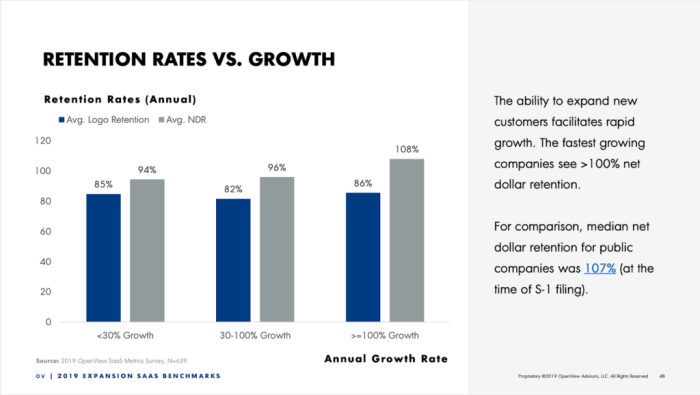
Customer retention and revenue growth are intrinsically linked, forming the bedrock of sustainable business success. Understanding the dynamics between acquiring new customers and retaining existing ones is crucial for long-term profitability. This exploration delves into effective strategies, key performance indicators (KPIs), and data-driven approaches to optimize both customer loyalty and revenue generation, ultimately leading to a thriving and resilient business model.
We’ll examine various methods for enhancing customer relationships, from implementing robust loyalty programs to leveraging the power of customer relationship management (CRM) systems. Furthermore, we’ll analyze customer behavior to identify high-value segments and predict future revenue streams. By understanding these key elements, businesses can develop targeted strategies that maximize both customer retention and revenue growth simultaneously.
Defining Customer Retention and Revenue Growth
Customer retention and revenue growth are intrinsically linked, forming the cornerstone of sustainable business success. Focusing on retaining existing customers is often more cost-effective than constantly acquiring new ones, and loyal customers frequently contribute significantly more to overall revenue over their lifetime. Understanding the dynamics between these two crucial aspects is essential for strategic planning and long-term profitability.Customer retention is the practice of keeping existing customers engaged and satisfied with your products or services, encouraging repeat purchases and ongoing loyalty.
Its impact on long-term success is profound, leading to reduced customer acquisition costs, increased profitability, and the establishment of a strong brand reputation. High retention rates foster a positive feedback loop, attracting new customers through word-of-mouth referrals and bolstering overall brand trust.High customer retention rates directly contribute to increased revenue growth. Returning customers are more likely to purchase additional products or services, upgrade their existing plans, and recommend your business to others.
This organic growth significantly reduces reliance on expensive marketing campaigns solely focused on acquiring new customers. The increased lifetime value (LTV) of a retained customer far outweighs the cost of acquiring a new one. Furthermore, a loyal customer base provides valuable feedback, assisting in product development and improving overall customer experience.
Key Performance Indicators (KPIs) for Customer Retention and Revenue Growth
Measuring customer retention and revenue growth requires tracking specific key performance indicators (KPIs). These metrics provide quantifiable data to assess the effectiveness of strategies and identify areas for improvement.Customer retention KPIs commonly include:* Customer Churn Rate: The percentage of customers lost over a specific period. A lower churn rate indicates higher retention.
Customer Lifetime Value (CLTV)
The predicted total revenue generated by a single customer over their entire relationship with the business. A higher CLTV signifies more profitable customers.
Repeat Purchase Rate
The percentage of customers who make repeat purchases within a defined timeframe. A high repeat purchase rate shows strong customer loyalty.
Net Promoter Score (NPS)
A measure of customer loyalty and satisfaction, indicating the likelihood of customers recommending your business to others.Revenue growth KPIs often include:* Year-over-Year (YoY) Revenue Growth: The percentage change in revenue compared to the previous year. A consistent positive YoY growth indicates healthy revenue expansion.
Monthly Recurring Revenue (MRR)
For subscription-based businesses, this represents the predictable revenue generated each month from subscriptions. Consistent MRR growth is a key indicator of success.
Average Revenue Per User (ARPU)
The average revenue generated per customer over a specific period. Increasing ARPU suggests successful upselling or cross-selling strategies.
Comparison of Customer Retention Strategies and Revenue Impact
The following table compares different customer retention strategies, outlining their implementation costs and projected revenue impact. It’s important to note that the projected revenue impact is an estimate and can vary based on various factors, including industry, target market, and the effectiveness of implementation.
| Strategy | Description | Implementation Cost | Projected Revenue Impact |
|---|---|---|---|
| Loyalty Programs | Rewarding repeat customers with discounts, exclusive offers, or points-based systems. | Medium (development and maintenance costs) | Medium to High (increased repeat purchases, higher CLTV) |
| Personalized Customer Service | Providing tailored support and communication based on individual customer needs and preferences. | Medium to High (training, technology investment) | High (improved customer satisfaction, reduced churn) |
| Proactive Customer Engagement | Regularly communicating with customers through newsletters, email updates, or targeted marketing campaigns. | Low to Medium (marketing automation tools, content creation) | Medium (increased brand awareness, repeat purchases) |
| Product Improvement Based on Feedback | Actively soliciting and incorporating customer feedback to enhance products and services. | Medium to High (research, development, and testing) | High (improved customer satisfaction, increased retention) |
Strategies for Improving Customer Retention
Improving customer retention is crucial for sustainable business growth. A focus on retention strategies not only reduces acquisition costs but also fosters brand loyalty and positive word-of-mouth marketing. By implementing effective strategies, businesses can cultivate lasting relationships with their customers, leading to increased profitability and a stronger market position.
Personalized Customer Experiences
Creating personalized experiences is paramount for fostering customer loyalty. This involves understanding individual customer preferences, purchase history, and interactions to tailor communications and offers. For example, a clothing retailer might send personalized email recommendations based on past purchases or browsing history, or a coffee shop might offer a personalized birthday reward. This level of attention shows customers that they are valued and understood, leading to increased engagement and repeat business.
Data-driven personalization allows businesses to anticipate customer needs and proactively address them, further enhancing the customer experience.
Proactive Customer Communication
Proactive communication is key to building strong customer relationships. This goes beyond simply responding to customer inquiries; it involves anticipating potential issues and proactively addressing them. For example, a software company might send regular updates about new features or security patches, or an e-commerce business might proactively reach out to customers who have abandoned their shopping carts. This proactive approach demonstrates a commitment to customer satisfaction and helps build trust.
Regular newsletters, personalized email campaigns, and proactive support significantly impact retention.
Exceptional Customer Service
Exceptional customer service is a cornerstone of customer retention. This involves providing prompt, efficient, and helpful support to customers whenever they need it. This might involve providing easy-to-access support channels, such as live chat, email, or phone, and ensuring that support agents are well-trained and empowered to resolve customer issues quickly and effectively. Going the extra mile to resolve a customer’s problem, even if it means exceeding expectations, can significantly improve customer satisfaction and loyalty.
Examples include offering refunds or replacements without hesitation and following up with customers after a problem has been resolved.
Loyalty Programs and Rewards
Implementing a well-designed loyalty program is a powerful way to incentivize repeat purchases and referrals. These programs should offer tiered rewards, increasing benefits as customers spend more or remain loyal for longer periods. For example, a tiered system might offer discounts, free products, or exclusive access to events at different levels. Effective communication about the program is crucial, keeping customers informed of their progress and upcoming rewards.
A strong loyalty program fosters a sense of community and belonging, making customers feel valued and appreciated. The program should be easily accessible and clearly communicated across all platforms.
Feedback Mechanisms and Continuous Improvement
Actively soliciting and responding to customer feedback is essential for continuous improvement. This might involve using surveys, feedback forms, or social media monitoring to gather insights into customer experiences. Analyzing this feedback can identify areas where the business can improve its products, services, or customer interactions. Showing customers that their feedback is valued and acted upon demonstrates a commitment to customer satisfaction and fosters loyalty.
Regularly reviewing and adapting strategies based on feedback ensures that the business is always striving to meet and exceed customer expectations. Transparency in how feedback is used builds trust and further strengthens the customer relationship.
Designing a Customer Loyalty Program
A successful customer loyalty program requires a strategic approach, focusing on clear tiers, attractive rewards, and effective communication. Consider a three-tier system: Bronze, Silver, and Gold. Bronze members might receive a 5% discount on purchases. Silver members could enjoy a 10% discount, free shipping, and early access to sales. Gold members could receive a 15% discount, exclusive events invitations, birthday gifts, and priority customer service.
Points could be earned for every dollar spent, and members could redeem points for rewards. Regular email updates, personalized offers based on purchase history, and social media engagement would keep members informed and engaged.
Proactive Customer Service and Churn Prevention
Proactive customer service is crucial for preventing churn. By anticipating customer needs and addressing potential problems before they escalate, businesses can significantly reduce customer attrition. This involves using CRM systems to track customer interactions and identify at-risk customers. Proactive measures could include personalized emails offering assistance or addressing specific concerns, offering discounts or incentives to retain customers, or conducting proactive customer satisfaction surveys.
Regular communication and personalized offers are effective tools in preventing customer churn. A robust customer support system that is easily accessible and responsive is essential.
Comparing CRM Systems for Customer Retention
Different CRM systems offer varying levels of functionality and effectiveness in improving customer retention. Some systems, like Salesforce, offer comprehensive features including contact management, sales automation, and marketing automation, which allow businesses to personalize customer interactions and track customer behavior effectively. Other systems, such as HubSpot, focus on inbound marketing and sales, providing tools for attracting and engaging customers.
The choice of CRM system depends on the specific needs and size of the business. Factors to consider include cost, scalability, integration with other systems, and ease of use. Each system should be evaluated based on its ability to support personalized communication, track customer interactions, and identify at-risk customers.
Analyzing Customer Behavior for Revenue Growth
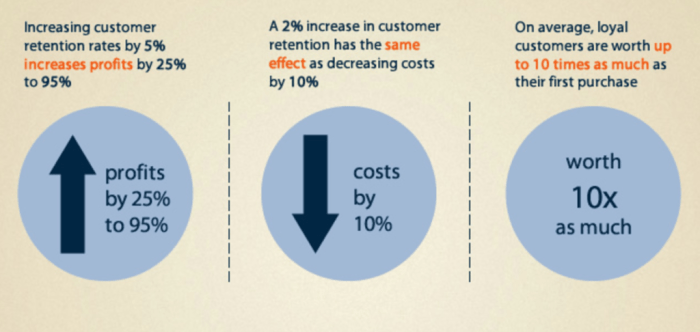
Understanding customer behavior is paramount for sustainable revenue growth. By analyzing purchasing patterns, preferences, and interactions, businesses can tailor strategies to enhance customer lifetime value and drive profitability. This involves segmenting customers, mapping their journeys, interpreting feedback, and leveraging data for predictive modeling.
Key Customer Segments Based on Purchasing Behavior and Lifetime Value
Identifying distinct customer segments allows for targeted marketing and resource allocation. Three key segments, often observed across various industries, are high-value customers, mid-value customers, and low-value customers. High-value customers exhibit high purchase frequency, large order sizes, and strong brand loyalty, contributing significantly to overall revenue. Mid-value customers represent a crucial segment with potential for growth through targeted engagement and upselling.
Low-value customers, while less profitable individually, can still contribute to overall revenue and may present opportunities for reactivation or targeted promotions. Analyzing these segments allows for customized strategies that maximize return on investment.
Customer Journey Map Illustrating Typical Customer Interactions
A customer journey map visually represents the steps a customer takes when interacting with a business, from initial awareness to post-purchase engagement. For example, a hypothetical online clothing retailer might map a customer journey including: awareness (seeing an ad on social media), consideration (browsing the website and reading product reviews), purchase (adding items to the cart and completing the checkout), retention (receiving email updates and participating in loyalty programs), and advocacy (leaving positive online reviews and recommending the brand to others).
This visual representation highlights potential pain points and opportunities for improvement at each stage, informing strategies to enhance the overall customer experience and drive revenue.
Understanding Customer Feedback to Inform Revenue Growth Strategies
Customer feedback, gathered through surveys, reviews, and social media monitoring, provides invaluable insights into customer satisfaction and areas for improvement. For instance, negative reviews highlighting slow shipping times might prompt the business to invest in faster logistics, thereby improving customer satisfaction and potentially boosting sales. Positive feedback, on the other hand, can be leveraged to reinforce successful strategies and identify opportunities for expansion or product development.
Analyzing both positive and negative feedback helps to create a holistic view of customer needs and preferences, ultimately guiding revenue-generating strategies.
Using Customer Data to Predict Future Revenue and Identify Potential Areas for Improvement
Predictive analytics utilizes historical customer data to forecast future revenue and identify potential areas for growth or improvement. For example, a retail store might use past sales data and seasonal trends to predict holiday sales and adjust inventory levels accordingly. Similarly, analyzing customer churn rate can highlight potential issues with customer service or product quality, allowing the business to proactively address these issues and prevent further losses.
By leveraging data-driven insights, businesses can make informed decisions that optimize resource allocation and maximize revenue potential. For instance, identifying a correlation between specific marketing campaigns and increased customer acquisition can inform future marketing investments.
Revenue Growth Strategies
Sustainable revenue growth is crucial for the long-term success of any business. It’s not just about attracting new customers; it’s about maximizing the value of existing ones and strategically expanding your market reach. This section explores various strategies to achieve robust and predictable revenue growth.
Pricing Models and Their Impact on Revenue Growth
Different pricing models significantly influence revenue growth, customer acquisition, and overall profitability. The optimal model depends on factors like customer value, perceived product/service value, market competition, and business goals. For example, a premium pricing strategy, while potentially limiting market reach, can establish a brand as high-quality and command higher profit margins. Conversely, a penetration pricing strategy, involving lower initial prices to gain market share, may sacrifice short-term profitability for long-term growth.
Value-based pricing, which sets prices based on the perceived value to the customer, often results in higher customer satisfaction and loyalty. Subscription models offer predictable recurring revenue streams, ideal for businesses with ongoing service offerings. Finally, freemium models, offering a basic service for free while charging for premium features, can attract a large user base and convert a portion into paying customers.
The selection of the right pricing model is critical for maximizing revenue growth.
Successful Upselling and Cross-selling Strategies
Upselling and cross-selling are powerful techniques to increase revenue per customer. Upselling involves encouraging customers to purchase a more expensive or premium version of a product or service they already intend to buy. For example, a customer ordering a basic web hosting package could be up-sold to a more robust package with added features like increased storage and bandwidth. Cross-selling involves offering complementary products or services to existing customers.
A coffee shop, for instance, might cross-sell pastries or sandwiches to customers who have ordered coffee. Effective upselling and cross-selling require a deep understanding of customer needs and preferences, and often involves personalized recommendations based on past purchase history or browsing behavior. Successful implementation relies on clear and concise communication highlighting the added value and benefits of the upsell or cross-sell offer.
Developing a Comprehensive Marketing Plan for Revenue Growth
A well-structured marketing plan is essential for driving revenue growth. This involves several key steps: firstly, defining your target audience – understanding their demographics, needs, and buying behavior is crucial for effective targeting. Secondly, selecting the appropriate marketing channels – this might include digital marketing (, social media, email marketing), traditional marketing (print advertising, direct mail), or a combination of both, depending on your target audience and budget.
Thirdly, crafting compelling messaging that resonates with your target audience and clearly communicates the value proposition of your product or service. Fourthly, establishing key performance indicators (KPIs) to track the effectiveness of your marketing efforts and make data-driven adjustments as needed. Finally, consistently monitoring and analyzing your results to optimize your campaigns and maximize return on investment (ROI).
A flexible and adaptable marketing plan, allowing for real-time adjustments based on performance data, is vital for sustained revenue growth.
Acquiring and Converting Customers into Loyal, High-Value Customers
Acquiring new customers and converting them into loyal, high-value customers is a multi-stage process. A successful approach involves a strategic blend of marketing, sales, and customer service efforts. The following flowchart illustrates a simplified representation of this process:[Imagine a flowchart here. The flowchart would start with “Marketing & Sales Activities (e.g., advertising, content marketing, lead generation)” leading to “Lead Qualification & Nurturing”.
This would then lead to “Conversion (e.g., purchase, signup)”. From “Conversion”, two branches would emerge: “Onboarding & Customer Support” leading to “Customer Retention & Loyalty Programs” and “Customer Feedback & Analysis” looping back to “Marketing & Sales Activities” creating a cyclical process. The “Customer Retention & Loyalty Programs” branch would then lead to “Upselling & Cross-selling” which ultimately leads to “High-Value Customer”.]The flowchart visually depicts the continuous loop of acquiring, nurturing, retaining, and growing customer value.
Successful navigation of this process requires a deep understanding of customer behavior, effective communication strategies, and a commitment to providing exceptional customer service.
Measuring and Tracking Progress
Tracking progress in customer retention and revenue growth requires a robust system for collecting, analyzing, and interpreting key performance indicators (KPIs). This data-driven approach allows businesses to understand what’s working, identify areas for improvement, and make informed decisions to optimize their strategies. A proactive monitoring system ensures that goals are met and adjustments are made in a timely manner.
Effective measurement involves selecting the right metrics, establishing clear benchmarks, and using appropriate tools to visualize the data. This allows for a comprehensive understanding of performance trends, enabling proactive adjustments to strategies and resource allocation. Regular review and analysis of this data are crucial for maintaining momentum and achieving sustainable growth.
Key Metrics and Tracking Methods
Several key metrics are essential for monitoring customer retention and revenue growth. These metrics should be tracked consistently to provide a clear picture of performance over time. The choice of metrics will depend on the specific business and its goals, but some common examples are included below.
- Customer Churn Rate: This metric measures the percentage of customers who stop doing business with a company within a specific period. A lower churn rate indicates better customer retention. It’s calculated as (Number of customers lost / Number of starting customers)
– 100. - Customer Lifetime Value (CLTV): This metric predicts the total revenue a business expects to generate from a single customer over their entire relationship with the company. A higher CLTV indicates a more valuable customer base.
- Customer Acquisition Cost (CAC): This metric measures the cost of acquiring a new customer. A lower CAC indicates more efficient marketing and sales efforts. It is calculated by dividing the total marketing and sales costs by the number of new customers acquired.
- Net Promoter Score (NPS): This metric measures customer loyalty and satisfaction by asking customers how likely they are to recommend the company to others. A higher NPS suggests strong customer loyalty and positive word-of-mouth marketing.
- Average Revenue Per User (ARPU): This metric measures the average revenue generated per user over a specific period. A higher ARPU indicates improved monetization strategies.
Dashboard and Report Examples
Visualizing data through dashboards and reports is crucial for effective monitoring and decision-making. These tools allow for quick identification of trends and areas needing attention.
A sample dashboard might include charts showing churn rate over time, CLTV segmented by customer type, CAC trends compared to marketing spend, and NPS scores compared to competitor benchmarks. Reports could delve deeper into specific areas, such as a detailed analysis of customer churn reasons or a breakdown of revenue streams by product or service.
For example, a line graph could illustrate the trend of the churn rate over the past year, highlighting any significant increases or decreases. A bar chart could compare the CLTV across different customer segments, allowing for a better understanding of which segments are most valuable. A heatmap could show the geographical distribution of customers and their purchasing behavior, helping to identify high-potential areas for expansion.
Regular Performance Reviews and Adjustments
Regular performance reviews are essential for ensuring that strategies remain effective and aligned with business goals. These reviews should involve analyzing the collected data, identifying areas of strength and weakness, and making necessary adjustments to strategies and resource allocation. The frequency of these reviews can vary depending on the business and the volatility of the market, but monthly or quarterly reviews are generally recommended.
For instance, if the churn rate is unexpectedly high, a review might reveal that a recent product update negatively impacted customer satisfaction. This information could then be used to inform decisions about product improvements, customer service enhancements, or targeted marketing campaigns.
Data Analysis and Informed Decision-Making
Analyzing the gathered data is crucial for making informed decisions to improve both customer retention and revenue growth. This involves identifying patterns, trends, and correlations between different metrics. Advanced analytical techniques, such as regression analysis or machine learning, can be used to predict future performance and optimize strategies proactively.
For example, by analyzing customer data, a business might discover that customers who engage with their social media channels have a higher CLTV. This insight could inform a decision to increase investment in social media marketing and community building. Similarly, identifying common reasons for customer churn through surveys or feedback analysis can lead to targeted improvements in products, services, or customer support.
Ultimately, achieving sustainable growth requires a holistic approach that prioritizes both customer retention and revenue generation. By implementing the strategies Artikeld—from proactive customer service and data-driven decision-making to effective marketing and pricing models—businesses can cultivate a loyal customer base that fuels consistent revenue growth. This symbiotic relationship ensures not only short-term gains but also long-term stability and competitive advantage in the marketplace.
Continuous monitoring and adaptation are key to optimizing these strategies for maximum impact.
Top FAQs
What is churn rate, and why is it important?
Churn rate is the percentage of customers who stop doing business with a company during a specific period. A high churn rate indicates problems with customer satisfaction or product/service value, directly impacting revenue growth. Tracking and reducing churn is critical.
How can I measure the lifetime value (LTV) of a customer?
LTV estimates the total revenue a customer will generate throughout their relationship with your business. Calculations typically involve factors like average purchase value, purchase frequency, and customer lifespan. Understanding LTV helps prioritize high-value customers and tailor retention strategies.
What are some examples of non-monetary rewards in a loyalty program?
Non-monetary rewards can include exclusive content (early access to products, webinars), personalized experiences (birthday discounts, dedicated customer support), or early access to sales and promotions. These can be just as effective as discounts in boosting customer loyalty.


