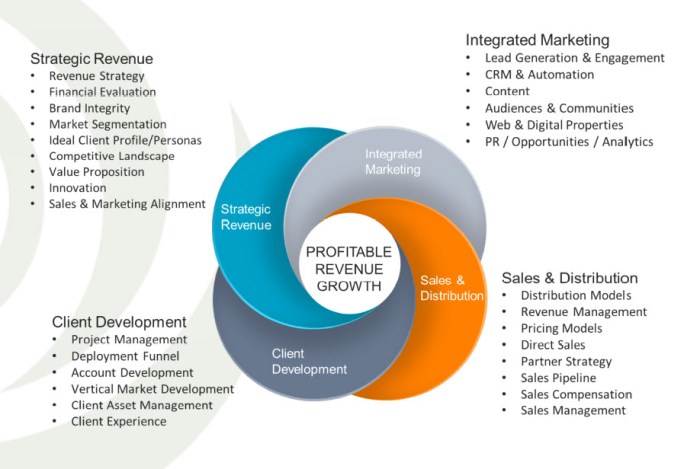
Boosting revenue is a critical goal for any business, and understanding the strategies to achieve sustainable growth is paramount. This guide delves into a multifaceted approach, exploring various avenues to expand revenue streams and enhance profitability. From analyzing existing revenue sources and market opportunities to implementing innovative pricing models and optimizing sales and marketing efforts, we will cover a comprehensive range of strategies to help businesses achieve their revenue targets.
We will examine how effective pricing strategies, coupled with targeted marketing campaigns and product innovation, can significantly impact a company’s bottom line. Furthermore, the importance of customer retention, operational efficiency, and strategic partnerships will be highlighted, providing a holistic perspective on achieving sustainable revenue growth.
Market Analysis & Opportunities
Understanding the market landscape is crucial for developing effective revenue growth strategies. A thorough analysis reveals not only the current market size and potential for expansion but also pinpoints underserved segments ripe for exploitation and areas where competitive differentiation can be achieved. This analysis will inform our strategic decisions, ensuring resources are focused on the most promising avenues for growth.Market size and growth potential are assessed using a combination of publicly available data, industry reports, and internal sales figures.
This integrated approach allows for a more comprehensive and nuanced understanding of the market dynamics.
Current Market Size and Growth Potential
The current market for [Product/Service Category] is estimated at [Dollar Amount] with a projected annual growth rate of [Percentage] over the next five years. This growth is driven primarily by [Key Market Drivers, e.g., increasing consumer demand, technological advancements, favorable regulatory environment]. For example, the increasing adoption of [related technology] in [specific industry] is fueling demand for our [specific product/service], contributing significantly to the overall market expansion.
This positive trajectory indicates a substantial opportunity for revenue growth.
Underserved Market Segments
Identifying underserved market segments is key to unlocking revenue expansion. Three such segments for our products/services are:
- Segment 1: [Segment Name, e.g., Small and Medium-sized Businesses (SMBs) in the rural sector]: This segment is characterized by [Segment Characteristics, e.g., limited access to sophisticated solutions, high demand for cost-effective alternatives]. Our [Product/Service] offers a unique value proposition by [Value Proposition, e.g., providing a simplified, affordable solution tailored to their specific needs].
- Segment 2: [Segment Name, e.g., Eco-conscious consumers]: Growing environmental awareness presents a significant opportunity. This segment values [Segment Values, e.g., sustainability, ethical sourcing]. Our [Product/Service] aligns perfectly with these values by [Alignment, e.g., utilizing recycled materials, minimizing environmental impact].
- Segment 3: [Segment Name, e.g., Tech-savvy professionals aged 25-40]: This demographic is characterized by [Segment Characteristics, e.g., early adoption of new technologies, high disposable income]. Our [Product/Service] caters to their need for [Need, e.g., efficient and user-friendly solutions] by [Solution, e.g., providing a seamless and intuitive user experience].
Competitive Landscape and Differentiation
The competitive landscape for [Product/Service Category] is [Competitive Landscape Description, e.g., highly competitive, with established players and emerging startups]. Key competitors include [Competitor Names]. However, our [Product/Service] differentiates itself through [Differentiation Points, e.g., superior technology, exceptional customer service, strong brand reputation]. For instance, unlike our competitors who focus solely on [Competitor Focus], we offer [Our Unique Offering] which has proven to be highly effective in [Example of Effectiveness].
This unique value proposition allows us to capture a significant share of the market.
SWOT Analysis for Revenue Growth
A SWOT analysis reveals opportunities for revenue growth by identifying internal strengths and weaknesses, and external opportunities and threats.
| Strengths | Weaknesses |
|---|---|
| [Strength 1, e.g., Strong brand reputation] | [Weakness 1, e.g., Limited marketing budget] |
| [Strength 2, e.g., Innovative technology] | [Weakness 2, e.g., Small sales team] |
| Opportunities | Threats |
| [Opportunity 1, e.g., Expanding into new geographical markets] | [Threat 1, e.g., Increasing competition] |
| [Opportunity 2, e.g., Developing new product features] | [Threat 2, e.g., Economic downturn] |
The SWOT analysis highlights opportunities such as leveraging our strong brand reputation to penetrate new markets and investing in R&D to develop innovative features that meet evolving customer needs. Addressing weaknesses, such as our limited marketing budget, through strategic partnerships and targeted campaigns will further amplify revenue growth potential.
Pricing Strategies
Effective pricing is crucial for revenue growth. A well-defined pricing strategy considers market dynamics, competitor actions, and the perceived value of your product or service. This section analyzes our current pricing model, explores alternative approaches, and details how value-based pricing can significantly boost revenue.
Competitor Pricing Analysis
Our current pricing strategy utilizes a value-based approach, emphasizing the long-term benefits and premium features of our software. However, a direct comparison with our main competitors reveals that “Competitor A” employs a competitive, volume-driven pricing model, offering lower prices to capture a larger market share. “Competitor B” uses a premium pricing strategy, focusing on a niche market willing to pay a higher price for specialized features.
“Competitor C” uses a freemium model, offering a basic version for free and charging for premium features. This competitive landscape necessitates a nuanced approach to optimize our pricing strategy for maximum revenue generation.
Alternative Pricing Models and Revenue Impact
Three alternative pricing models warrant consideration: subscription-based pricing, tiered pricing, and usage-based pricing.A subscription-based model, offering access to our software for a recurring fee, could provide predictable and recurring revenue streams, increasing customer lifetime value. However, it requires a strong customer acquisition strategy to offset initial costs. Tiered pricing, offering different feature sets at varying price points, allows customers to choose a plan that best fits their needs and budget, potentially increasing revenue by upselling higher-tier plans.
Usage-based pricing, charging based on the amount of software usage, can incentivize higher usage and generate revenue proportionate to consumption. This model may, however, lead to unpredictable revenue streams.
Value-Based Pricing for Revenue Increase
Value-based pricing focuses on the perceived value a customer receives from your product or service, rather than solely on cost. By clearly communicating the benefits and ROI of our software, we can justify a higher price point. For example, highlighting the time saved, increased efficiency, and improved decision-making capabilities of our software can demonstrate its value proposition and encourage customers to perceive a higher value, justifying a price premium.
This approach is especially effective in targeting enterprise clients who value efficiency and productivity enhancements over simple cost savings. A successful implementation would require meticulous market research and effective communication of the value proposition through case studies, testimonials, and targeted marketing campaigns.
Pricing Matrix and Projected Revenue Impact
The following table illustrates a potential tiered pricing structure and its projected revenue impact, based on estimated customer acquisition and retention rates for each tier. These projections are based on similar models used by competitors and internal sales data.
| Pricing Tier | Features | Monthly Price | Projected Annual Revenue (USD) |
|---|---|---|---|
| Basic | Core functionalities, limited user access | $29 | $100,000 |
| Standard | All basic features, advanced analytics, 10 user licenses | $99 | $500,000 |
| Premium | All standard features, custom integrations, unlimited users, priority support | $299 | $1,500,000 |
| Enterprise | All premium features, dedicated account manager, customized solutions | Custom Pricing | $3,000,000 |
Sales & Marketing Enhancements
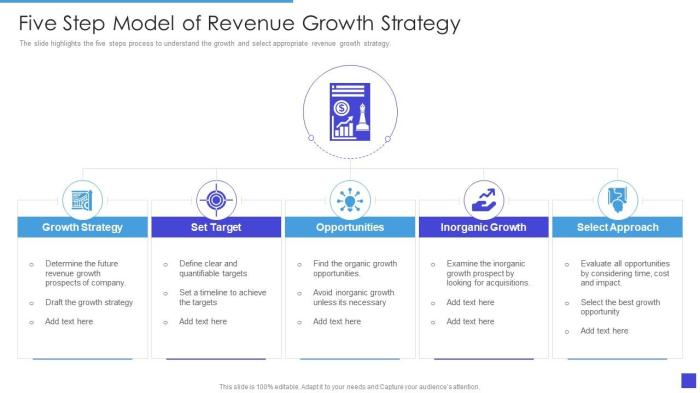
Optimizing sales and marketing efforts is crucial for sustainable revenue growth. By identifying underperforming areas, improving customer acquisition and lifetime value, enhancing conversion rates, and forging strategic partnerships, we can significantly boost revenue. This section details actionable strategies to achieve these goals.
Underperforming Marketing Channels and Improvements
A thorough analysis of marketing channel performance is essential. Let’s assume three channels are underperforming: social media advertising (specifically, Facebook ads), email marketing, and content marketing (blog posts and articles). Improvements for each can be implemented as follows:
- Facebook Ads: Current campaigns may lack precise targeting. Improvement involves refining audience segmentation based on demographics, interests, and behaviors. A/B testing different ad creatives and copy is also crucial. Furthermore, implementing retargeting campaigns to re-engage website visitors can significantly improve ROI.
- Email Marketing: Low open and click-through rates suggest issues with email list hygiene and engagement. Improvement requires segmenting the email list based on customer behavior and preferences, personalizing email content, and optimizing email subject lines for higher open rates. A/B testing different email subject lines and content is essential for optimization.
- Content Marketing: Low organic traffic indicates a need for improved content strategy and optimization. Improvement involves conducting research to identify relevant search terms, optimizing content for search engines, and promoting content through social media and other channels. Creating high-quality, valuable content that addresses customer needs is paramount.
Improving Customer Acquisition Cost (CAC) and Customer Lifetime Value (CLTV)
Reducing CAC and increasing CLTV are key to profitability. Strategies to achieve this include:
- Reduce CAC: Implementing more effective targeting in marketing campaigns, optimizing landing pages for conversions, and leveraging free or low-cost marketing channels (such as organic social media and content marketing) can lower CAC. For example, focusing on highly targeted Facebook ad campaigns instead of broad reach campaigns can drastically reduce wasted ad spend.
- Increase CLTV: Implementing loyalty programs, providing exceptional customer service, and upselling/cross-selling products or services can increase CLTV. For instance, a subscription-based model can increase customer retention and drive recurring revenue, significantly boosting CLTV. Furthermore, personalized email marketing campaigns can encourage repeat purchases and engagement.
Improving the ratio of CLTV to CAC is a crucial metric for sustainable growth. A healthy CLTV:CAC ratio generally sits above 3:1.
Increasing Sales Conversion Rates
Conversion rate optimization (CRO) is vital for revenue growth. Strategies include:
- Website Optimization: Improving website design, navigation, and user experience (UX) can significantly improve conversion rates. This includes optimizing website speed, ensuring mobile responsiveness, and implementing clear calls-to-action (CTAs).
- Sales Process Improvement: Streamlining the sales process, reducing friction points, and providing excellent customer service can also increase conversion rates. This may involve simplifying the checkout process, offering multiple payment options, and providing personalized support.
- A/B Testing: Continuously testing different elements of the website and marketing materials (e.g., headlines, images, CTAs) to identify what works best and optimize for higher conversion rates is critical.
Potential Strategic Partnerships
Strategic partnerships can unlock significant revenue growth opportunities. Examples include:
- Complementary Businesses: Partnering with businesses that offer complementary products or services can expand your reach and attract new customers. For example, a coffee shop could partner with a local bakery to offer bundled deals.
- Influencers: Collaborating with relevant influencers can increase brand awareness and drive sales. For example, partnering with a fitness influencer to promote athletic wear could significantly increase brand reach and sales.
- Technology Providers: Integrating with technology providers can improve efficiency and expand capabilities. For example, integrating with a CRM system can improve customer relationship management and sales processes.
Product Development & Innovation
Driving sustainable revenue growth necessitates a robust product development and innovation strategy. This involves identifying new market opportunities, developing compelling products and services, and enhancing existing offerings to maximize their market appeal and profitability. A well-defined roadmap is crucial for aligning these efforts with overall business objectives.Product development and innovation are not simply about creating new products; it’s about strategically expanding the product portfolio to cater to evolving customer needs and market trends, ultimately boosting revenue streams.
This section will explore three potential new product ideas, analyze their market viability, and Artikel a roadmap for their development.
New Product/Service Ideas and Market Analysis
Three new product or service ideas, with potential for significant revenue generation, are presented below. Each idea considers market trends and potential profitability, incorporating realistic assessments based on comparable successful products and services.
- Premium Subscription Tier: Offering a premium subscription tier to our existing service could unlock significant revenue. This tier would include exclusive features, such as priority customer support, advanced analytics, and access to beta versions of new functionalities. Market demand is evident in the success of premium subscription models in similar industries, such as streaming services (Netflix, Spotify) and software applications (Adobe Creative Cloud).
Profitability hinges on setting an appropriate price point that balances value proposition with market acceptance, potentially yielding a higher average revenue per user (ARPU).
- Integrated Solution Package: Developing an integrated solution package that bundles our existing services with complementary offerings could attract new customers and increase sales to existing ones. For example, a software company might bundle its core software with training and consulting services. Market demand is based on the convenience and cost-effectiveness of bundled solutions, seen in the success of telecommunication packages and software suites.
Profitability depends on careful cost analysis and pricing strategies to ensure a competitive advantage and attractive profit margins.
- White-Label Service Offering: Offering our core service as a white-label solution to other businesses could open up a new revenue stream. This involves providing our technology and expertise to other companies who can then resell it under their own brand. Market demand exists within industries where companies prioritize outsourcing non-core functions, similar to the success of white-label e-commerce platforms and payment gateways.
Profitability depends on effective partnership development, scalable infrastructure, and efficient cost management.
Impact of Product Enhancements on Existing Revenue Streams
Strategic product enhancements can significantly impact existing revenue streams, either by increasing sales of existing products or creating new revenue opportunities. For example, adding new features to an existing software application can increase its appeal to existing customers and attract new ones, leading to higher subscription revenue. Similarly, improving the user experience through interface redesign can boost customer satisfaction and reduce churn, thereby improving the lifetime value of each customer.
Product Development and Innovation Roadmap
A phased approach is vital for effective product development and innovation. This roadmap Artikels key steps and timelines for launching the three new product ideas mentioned previously.
| Phase | Activity | Timeline | Metrics |
|---|---|---|---|
| Phase 1: Ideation & Market Research (3 months) | Conduct thorough market research, validate product ideas, and refine product specifications. | Months 1-3 | Market size, competitor analysis, customer feedback |
| Phase 2: Development & Testing (6 months) | Develop minimum viable products (MVPs) for each new offering and conduct rigorous testing to ensure quality and functionality. | Months 4-9 | Beta testing results, bug fixes, user feedback |
| Phase 3: Launch & Marketing (3 months) | Launch the new products/services and implement comprehensive marketing campaigns to drive adoption and sales. | Months 10-12 | Sales figures, customer acquisition cost, market share |
| Phase 4: Iteration & Enhancement (Ongoing) | Continuously monitor performance, gather customer feedback, and iterate on product design and functionality to optimize revenue generation. | Ongoing | Customer satisfaction, revenue growth, feature adoption |
Customer Retention & Upselling
Customer retention and upselling are crucial for sustainable revenue growth. Focusing on these areas allows businesses to maximize the lifetime value of each customer, reducing reliance on constantly acquiring new ones. By fostering strong customer relationships and strategically offering additional products or services, companies can significantly boost profitability.
Improving customer retention and implementing effective upselling strategies requires a multi-faceted approach encompassing personalized communication, proactive support, and a deep understanding of customer needs and preferences. This involves analyzing customer data to identify trends and patterns, allowing for targeted interventions to prevent churn and increase sales.
Strategies for Improving Customer Retention Rates
Several strategies contribute to higher customer retention rates. These range from proactive communication and personalized service to loyalty programs and feedback mechanisms. Effective implementation requires consistent monitoring and adaptation based on performance data.
- Proactive Customer Support: Addressing customer issues quickly and efficiently, even before they escalate, demonstrates a commitment to customer satisfaction and fosters loyalty.
- Personalized Communication: Tailoring communications to individual customer needs and preferences, through targeted email campaigns or personalized recommendations, increases engagement and strengthens the relationship.
- Loyalty Programs: Rewarding loyal customers with exclusive benefits, discounts, or early access to new products creates a strong incentive to continue doing business with the company.
- Regular Feedback Mechanisms: Actively soliciting customer feedback through surveys, reviews, or direct communication channels allows businesses to identify areas for improvement and address potential issues before they lead to churn.
Methods for Upselling and Cross-selling Existing Products/Services
Upselling and cross-selling are effective techniques to increase revenue from existing customers. Successful implementation relies on understanding customer needs and presenting relevant offers at the right time and in the right context.
- Targeted Offers: Based on past purchases or browsing history, offer complementary products or upgrades that enhance the customer’s existing experience. For example, a coffee shop could upsell a customer from a small coffee to a larger size or offer a pastry alongside their drink.
- Bundling Products: Offering discounted packages or bundles of products or services can incentivize customers to purchase more. A software company might bundle additional features or support services with their core product.
- Strategic Product Placement: Positioning upsell or cross-sell opportunities strategically within the customer journey, such as during the checkout process or in personalized email communications, increases the likelihood of conversion.
- Personalized Recommendations: Utilizing data analysis to recommend products or services relevant to individual customer profiles enhances the effectiveness of upselling and cross-selling efforts. An online retailer might suggest items frequently purchased together or products similar to those previously bought by the customer.
Examples of Successful Customer Loyalty Programs
Many companies have successfully implemented loyalty programs to retain customers and increase revenue. These programs often offer tiered rewards, exclusive benefits, and personalized experiences to foster customer loyalty.
- Starbucks Rewards: Offers points for purchases, free drinks, and personalized offers based on past orders.
- Sephora Beauty Insider: Provides tiered benefits including birthday gifts, exclusive events, and early access to new products.
- Amazon Prime: Offers free shipping, streaming services, and other benefits for an annual fee, creating a strong incentive for continued usage.
Customer Retention Strategy
A comprehensive customer retention strategy requires a structured approach with clearly defined actions and timelines. This ensures consistent effort and measurable results.
- Phase 1 (Months 1-3): Implement a customer satisfaction survey to gather feedback. Analyze customer data to identify churn risk factors. Develop a personalized communication strategy based on customer segments.
- Phase 2 (Months 4-6): Launch a loyalty program with tiered rewards. Implement a proactive customer support system to address issues promptly. A/B test different upselling and cross-selling strategies.
- Phase 3 (Months 7-12): Analyze the effectiveness of the loyalty program and make adjustments as needed. Refine the personalized communication strategy based on performance data. Develop new upselling and cross-selling opportunities based on customer feedback.
Implementing a robust revenue growth strategy requires a holistic approach that encompasses market analysis, pricing optimization, sales and marketing enhancements, product innovation, and operational efficiency improvements. By strategically prioritizing these areas and consistently monitoring key performance indicators, businesses can achieve sustainable revenue growth and long-term success. This guide has provided a framework; consistent application and adaptation to specific business contexts are crucial for achieving optimal results.
Detailed FAQs
What is the difference between CAC and CLTV?
Customer Acquisition Cost (CAC) is the cost of acquiring a new customer, while Customer Lifetime Value (CLTV) is the predicted revenue a customer will generate throughout their relationship with the business. A healthy business will have a CLTV significantly higher than its CAC.
How can I identify underperforming marketing channels?
Analyze your marketing analytics data. Look at metrics like conversion rates, cost per acquisition, and return on investment (ROI) for each channel. Channels with consistently low ROI should be investigated for improvement or potential elimination.
What are some examples of value-based pricing?
Value-based pricing focuses on the perceived value to the customer. Examples include premium pricing for high-quality products, tiered pricing based on features, and personalized pricing based on individual customer needs.


