
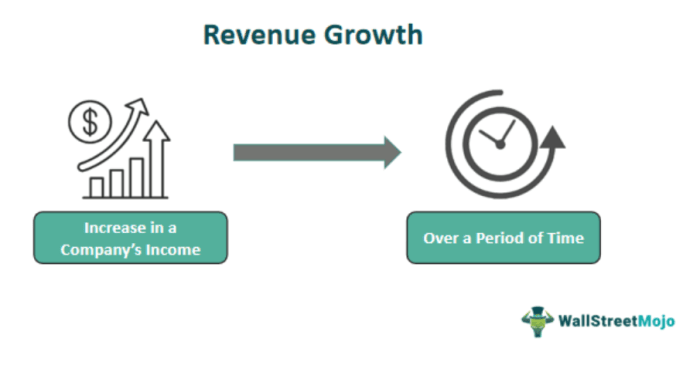
Understanding revenue growth is crucial for any business, regardless of size. It represents the increase in a company’s income over a specific period, reflecting its ability to generate sales and expand its market presence. This growth can stem from various sources, including increased sales volume, higher prices, or the introduction of new products or services. Analyzing revenue growth provides invaluable insights into a company’s overall health and potential for future success.
This exploration delves into the multifaceted nature of revenue growth, examining its definition, influencing factors, measurement methods, and strategies for improvement. We’ll also explore the crucial relationship between revenue growth and profitability, and how to effectively forecast future growth. By understanding these key aspects, businesses can make informed decisions to achieve sustainable and profitable expansion.
Defining Revenue Growth
Revenue growth represents the increase in a company’s revenue over a specific period. It’s a fundamental indicator of a business’s financial health and its ability to generate income. Understanding revenue growth is crucial for making informed business decisions, attracting investors, and ensuring long-term sustainability.Revenue growth can be achieved through various strategies, leading to different classifications. Analyzing these different approaches helps businesses tailor their growth strategies for optimal results.
Types of Revenue Growth
There are several ways a company can experience revenue growth. Two primary categories are organic and inorganic growth. Organic growth is achieved through internal efforts, such as expanding into new markets, increasing product offerings, or improving marketing strategies. Inorganic growth, conversely, involves external activities like mergers, acquisitions, or strategic partnerships. For example, a clothing retailer might experience organic growth by opening new stores and improving its online presence.
The same retailer could experience inorganic growth by acquiring a smaller, competing brand.
Absolute and Percentage Revenue Growth
While both absolute and percentage revenue growth measure increases in revenue, they offer different perspectives. Absolute revenue growth simply represents the difference between the revenue in two periods (e.g., $1 million increase from $10 million to $11 million). Percentage revenue growth, however, normalizes the increase relative to the initial revenue, providing a more comparable metric across different business sizes.
It is calculated as [(Revenue in period 2 – Revenue in period 1) / Revenue in period 1]100%. For instance, a company with $10 million in revenue experiencing a $1 million increase shows 10% percentage growth, while a company with $100 million in revenue seeing the same $1 million increase shows only a 1% percentage growth. Percentage growth offers a clearer picture of growth rate relative to the starting point.
Importance of Tracking Revenue Growth
Tracking revenue growth is vital for businesses of all sizes. For small businesses, it helps monitor the effectiveness of sales strategies and identify areas needing improvement. Larger companies use revenue growth tracking to evaluate the performance of different divisions, assess the impact of major investments, and make informed decisions about resource allocation. Consistent monitoring allows for proactive adjustments to business strategies, ensuring continued growth and profitability.
Furthermore, investors heavily rely on revenue growth figures to gauge a company’s potential and make investment decisions. A consistently increasing revenue stream signals a healthy and expanding business, making it more attractive to potential investors.
Factors Influencing Revenue Growth
Revenue growth, the increase in a company’s sales over time, is a multifaceted process influenced by a complex interplay of internal and external factors. Understanding these influences is crucial for businesses aiming to achieve sustainable and predictable growth. This section will explore the key drivers of revenue growth, examining both internal strategies and external market conditions.
Internal Factors Contributing to Revenue Growth
Internal factors are those directly controlled by the company. These factors represent the company’s ability to effectively manage its resources and operations to boost sales. Strong internal capabilities significantly contribute to a company’s ability to capitalize on market opportunities.
- Product Innovation and Development: Introducing new products or significantly improving existing ones can attract new customers and increase sales among existing ones. For example, Apple’s consistent release of innovative iPhones has fueled significant revenue growth over the years.
- Operational Efficiency: Streamlining operations, improving supply chain management, and reducing production costs can increase profit margins and allow for more competitive pricing, ultimately driving revenue growth. Companies like Toyota, renowned for their lean manufacturing processes, exemplify this approach.
- Sales and Marketing Effectiveness: A robust sales team and effective marketing campaigns are crucial for reaching target audiences and converting leads into sales. Companies like Coca-Cola, with their extensive global marketing reach, demonstrate the power of effective marketing.
- Customer Retention and Loyalty Programs: Retaining existing customers is often cheaper than acquiring new ones. Loyalty programs and excellent customer service contribute to higher customer lifetime value and sustained revenue growth. Amazon’s Prime membership program is a prime example of successful customer retention.
External Market Factors Affecting Revenue Growth
External factors are those outside the company’s direct control, impacting its revenue growth potential. Understanding and adapting to these factors is essential for successful revenue generation.
- Economic Conditions: Recessions, inflation, and economic growth directly impact consumer spending and business investment, influencing the demand for products and services. During periods of economic expansion, revenue growth tends to be higher.
- Competitive Landscape: The presence and actions of competitors significantly impact a company’s market share and revenue. Intense competition may necessitate price adjustments or increased marketing investment to maintain or grow revenue.
- Technological Advancements: Technological disruptions can create new market opportunities or render existing products obsolete. Companies must adapt to technological changes to remain competitive and sustain revenue growth. The rise of e-commerce has dramatically altered the retail landscape, forcing traditional brick-and-mortar stores to adapt or face declining revenue.
- Regulatory Environment: Government regulations, taxes, and trade policies can influence business operations and revenue. Changes in regulations may require companies to adjust their strategies to remain compliant and maintain profitability.
The Role of Pricing Strategies in Driving Revenue Growth
Pricing strategies play a vital role in determining revenue. Different strategies can be employed depending on the company’s goals and market conditions.
- Value-Based Pricing: This strategy sets prices based on the perceived value of the product or service to the customer. It can command premium prices but requires a strong value proposition.
- Cost-Plus Pricing: This involves calculating the cost of production and adding a markup to determine the selling price. It ensures profitability but may not optimize revenue if the market is price-sensitive.
- Competitive Pricing: This strategy sets prices based on competitor pricing. It can be effective in competitive markets but may lead to price wars and reduced profitability.
- Penetration Pricing: This involves setting low prices initially to gain market share and then gradually increasing prices. It is effective for new products entering a market but may result in lower profit margins initially.
Comparison of Marketing Strategies and Their Effect on Revenue
Marketing strategies significantly impact revenue generation. Different strategies cater to various target audiences and market conditions.
| Marketing Strategy | Description | Effect on Revenue | Example |
|---|---|---|---|
| Digital Marketing | Utilizing online channels like social media, search engines, and email marketing. | Can generate high ROI, particularly for targeting specific demographics. | Influencer marketing campaigns on Instagram. |
| Content Marketing | Creating valuable and engaging content to attract and retain customers. | Builds brand awareness and trust, leading to long-term revenue growth. | A blog providing informative articles related to a company’s products. |
| Traditional Marketing | Utilizing offline channels like print advertising, television, and radio. | Can reach a broad audience but may have lower ROI compared to digital marketing. | Television commercials during primetime viewing hours. |
| Affiliate Marketing | Partnering with other businesses or influencers to promote products or services. | Can generate significant revenue through commission-based arrangements. | Amazon’s affiliate program. |
Measuring Revenue Growth
Understanding how to measure revenue growth is crucial for businesses to track their progress, identify areas for improvement, and make informed decisions. Accurate measurement requires selecting appropriate methods and key performance indicators (KPIs) that align with the business’s specific goals and industry context.
Revenue Growth Rate Calculation Methods
Several methods exist for calculating revenue growth rates, each offering a slightly different perspective on the trajectory of a business’s revenue. The choice of method depends on the timeframe and the desired level of detail.
The most common method is calculating the year-over-year (YoY) growth rate. This compares revenue from one year to the revenue from the previous year. The formula is:
((Current Year Revenue – Previous Year Revenue) / Previous Year Revenue) – 100%
For example, if a company’s revenue was $1 million in 2022 and $1.2 million in 2023, the YoY growth rate would be: (($1.2 million – $1 million) / $1 million)
– 100% = 20%.
Another method is the compound annual growth rate (CAGR). CAGR smooths out fluctuations in revenue over multiple years, providing a more consistent picture of long-term growth. The formula is more complex:
CAGR = [(Ending Value / Beginning Value)^(1 / Number of years)] – 1
For instance, if a company’s revenue grew from $1 million to $1.7 million over five years, the CAGR would be: [($1.7 million / $1 million)^(1/5)]
-1 ≈ 10.76%.
Finally, monthly or quarterly growth rates can provide a more granular view of revenue trends, allowing for quicker identification of both positive and negative shifts.
Key Performance Indicators (KPIs) for Revenue Growth
Several KPIs provide valuable insights into the drivers and overall health of revenue growth. These metrics go beyond simple growth rates, offering a deeper understanding of the underlying factors contributing to revenue changes.
These KPIs can be categorized into those focused on the top line (revenue itself) and those related to the underlying drivers of revenue. Examples include:
| Metric Name | Formula | Description | Example |
|---|---|---|---|
| Year-over-Year (YoY) Revenue Growth | ((Current Year Revenue – Previous Year Revenue) / Previous Year Revenue) – 100% | Percentage change in revenue from one year to the next. | 20% increase |
| Customer Acquisition Cost (CAC) | Total Marketing & Sales Costs / Number of New Customers | Cost of acquiring a new customer. | $500 per customer |
| Average Revenue Per User (ARPU) | Total Revenue / Number of Users | Average revenue generated per user. | $100 per user |
| Customer Lifetime Value (CLTV) | Average Purchase Value
|
Predicted revenue generated by a single customer over their entire relationship with the business. | $2000 per customer |
Analyzing Revenue Growth Trends
Analyzing revenue growth trends involves a systematic approach using historical data to identify patterns, pinpoint areas of strength and weakness, and inform future strategies.
The steps generally include:
- Data Collection and Preparation: Gather historical revenue data, ensuring accuracy and consistency in measurement.
- Calculate Key Metrics: Compute relevant revenue growth rates and KPIs, such as YoY growth, CAGR, ARPU, and CLTV.
- Visualize the Data: Create charts and graphs to visually represent revenue trends over time. This allows for easy identification of patterns and anomalies.
- Identify Trends and Patterns: Analyze the calculated metrics and visualizations to identify upward or downward trends, seasonal fluctuations, or other significant patterns.
- Analyze Contributing Factors: Investigate the underlying drivers behind the observed trends, considering factors like marketing campaigns, product launches, economic conditions, and competition.
- Develop Insights and Forecasts: Based on the analysis, develop insights into the business’s performance and make informed predictions about future revenue growth.
Strategies for Improving Revenue Growth
Boosting revenue requires a multifaceted approach, strategically combining various techniques to achieve sustainable growth. Understanding your target market, analyzing your current performance, and identifying opportunities for improvement are crucial first steps. This section will explore several key strategies businesses can employ to significantly increase their revenue streams.
Expanding into New Markets
Entering new geographic locations or targeting previously untapped customer segments can dramatically increase revenue. This expansion can involve physical expansion, such as opening new stores or offices, or digital expansion, through online marketplaces and targeted advertising campaigns. For example, Starbucks’ global expansion into diverse markets reflects a successful strategy of reaching new customer bases. This strategy, while offering significant potential for growth, requires thorough market research to assess the viability and potential risks associated with each new market.
Failure to understand cultural nuances or local regulations can lead to costly mistakes.
Developing New Products or Services
Introducing innovative products or services that meet unmet customer needs or improve existing offerings is a powerful revenue driver. This requires ongoing research and development to stay ahead of market trends and competitor offerings. Apple’s continuous innovation in consumer electronics, introducing new iPhones and other devices with enhanced features, exemplifies this strategy. However, new product development carries inherent risks, including high development costs and the possibility of market failure if the product doesn’t resonate with consumers.
Thorough market testing and a well-defined go-to-market strategy are crucial to mitigate these risks.
Improving Customer Retention and Loyalty
Retaining existing customers is often more cost-effective than acquiring new ones. Implementing loyalty programs, personalized marketing campaigns, and excellent customer service can significantly improve customer retention rates and boost revenue through repeat purchases and referrals. Amazon’s Prime membership program is a prime example of a successful customer retention strategy, providing benefits that incentivize continued engagement and spending. The drawback lies in the investment required to build and maintain such programs, and the potential for reduced profitability if customer acquisition costs remain high.
Optimizing Pricing Strategies
Strategic pricing adjustments can significantly impact revenue. This involves carefully considering factors such as competitor pricing, production costs, and customer willingness to pay. Implementing value-based pricing, where the price reflects the perceived value of the product or service, can be highly effective. However, incorrect pricing can lead to lost sales or reduced profitability. Thorough market analysis and a deep understanding of customer price sensitivity are essential for successful price optimization.
Enhancing Sales and Marketing Efforts
Investing in effective sales and marketing campaigns is crucial for driving revenue growth. This involves identifying the most effective channels to reach target customers, crafting compelling marketing messages, and optimizing sales processes. Companies like Nike successfully leverage social media marketing and influencer collaborations to reach a wider audience and boost sales. However, ineffective marketing campaigns can lead to wasted resources and a poor return on investment.
Careful planning, data-driven decision-making, and continuous monitoring of campaign performance are critical to success.
Developing a Comprehensive Revenue Growth Plan
A successful revenue growth plan requires a structured approach. It should begin with a thorough analysis of the current market landscape, competitive analysis, and an assessment of the company’s strengths and weaknesses. This analysis should inform the selection of appropriate strategies, setting realistic and measurable goals, and allocating resources effectively. The plan should also incorporate a system for tracking progress, analyzing results, and making adjustments as needed.
Regular review and adaptation are essential to ensure the plan remains relevant and effective in a dynamic business environment. For example, a company might set a goal of increasing revenue by 15% in the next year, outlining specific strategies to achieve this goal, including market expansion, product development, and marketing initiatives. The plan would then detail the resources needed, timelines, and key performance indicators (KPIs) to monitor progress.
Analyzing Revenue Growth Data
Analyzing revenue growth data is crucial for understanding a business’s performance and making informed strategic decisions. By examining trends and patterns, businesses can identify areas of strength and weakness, predict future performance, and adjust their strategies accordingly. This analysis goes beyond simply looking at the numbers; it involves interpreting the data within the context of market conditions, competitive landscape, and internal operations.Interpreting Revenue Growth Trends Over TimeRevenue growth trends, when viewed over time, reveal valuable insights into the sustainability and health of a company’s revenue streams.
Consistent, upward growth indicates a healthy business model and strong market position. Conversely, declining or stagnant growth signals potential problems requiring immediate attention. Analyzing growth rates year-over-year (YoY) and quarter-over-quarter (QoQ) helps pinpoint periods of acceleration or deceleration, providing a clearer picture of the underlying drivers. For instance, a company might experience rapid growth in one quarter due to a successful marketing campaign, but then see a slowdown in subsequent quarters if that campaign isn’t sustained.
Identifying these fluctuations and their causes is key to developing effective long-term strategies.Potential Challenges and Opportunities Revealed by Revenue Growth AnalysisAnalyzing revenue growth data can highlight both challenges and opportunities. Slowing growth might indicate the need for product diversification, improved marketing strategies, or cost reduction measures. Conversely, rapid growth can present challenges related to scaling operations, managing cash flow, and maintaining quality.
For example, a sudden surge in demand could strain supply chains, leading to delays and potentially damaging customer relationships if not managed effectively. Therefore, understanding the reasons behind growth patterns—whether positive or negative—is critical for proactive planning and mitigation of risks.Visual Representation of Hypothetical Revenue GrowthImagine a line graph charting revenue over a five-year period. The Y-axis represents revenue in millions of dollars, and the X-axis represents the years.
The line starts relatively flat in years one and two, indicating slow initial growth. In year three, the line sharply ascends, representing a period of significant growth likely driven by a new product launch or successful marketing initiative. In year four, the line levels off slightly, reflecting a period of consolidation or market saturation. Finally, in year five, the line shows a more gradual but steady incline, suggesting sustainable growth and market stability.
The sharp increase in year three is a clear data point, while the leveling off in year four and the steadier growth in year five demonstrate the changing dynamics over time.Questions to Ask When Analyzing Revenue Growth DataUnderstanding the underlying causes of revenue growth requires asking probing questions. For example, examining the contribution of different product lines or customer segments can reveal which areas are driving growth and which are lagging.
Analyzing the impact of marketing campaigns, pricing strategies, and sales efforts helps determine the effectiveness of various initiatives. Furthermore, investigating changes in market share, competitive activity, and economic conditions provides valuable context for interpreting revenue trends. Finally, internal factors such as operational efficiency, employee productivity, and technological advancements also need to be considered. By asking these questions, a comprehensive understanding of the drivers of revenue growth can be obtained.
Revenue Growth and Profitability
Revenue growth and profitability are intrinsically linked, yet they don’t always move in perfect harmony. While increased revenue is crucial for business expansion, it’s profitability that ultimately determines long-term sustainability and success. Understanding the nuanced relationship between these two key metrics is vital for effective strategic planning.High revenue growth doesn’t automatically equate to high profitability. Several factors can decouple these two aspects, leading to scenarios where a company experiences significant top-line growth but struggles to translate that into bottom-line profits.
This can be a serious concern, as unsustainable growth fueled by low margins can ultimately lead to financial instability.
Scenarios of High Revenue Growth with Low Profitability
Rapid expansion often requires significant upfront investments in areas like marketing, sales, and infrastructure. These costs can significantly impact profit margins, even if revenue is increasing rapidly. For instance, a company aggressively pursuing market share might offer deep discounts or engage in extensive advertising campaigns, boosting sales but shrinking profit per unit. Similarly, scaling operations quickly can lead to inefficiencies and increased operational expenses that outweigh the benefits of increased revenue.
Another common scenario involves offering a product or service with low profit margins, relying on high volume to compensate. While this strategy can generate impressive revenue figures, it leaves the company vulnerable to price wars or changes in market demand.
Balancing Revenue Growth and Profit Margins
Companies employ various strategies to achieve a balance between revenue growth and profit margins. One approach focuses on optimizing pricing strategies, finding the sweet spot between maximizing revenue and maintaining acceptable profit margins. This often involves a detailed analysis of customer segmentation, price elasticity, and competitor pricing. Another approach centers on improving operational efficiency. Streamlining processes, automating tasks, and negotiating better deals with suppliers can all contribute to higher profit margins without necessarily sacrificing revenue growth.
A third strategy involves careful product development and innovation. Focusing on products or services with higher profit margins can be a more sustainable approach to long-term profitability than solely pursuing high-volume sales of low-margin products.
Examples of Companies Balancing Revenue Growth and Profitability
Apple consistently demonstrates a strong ability to balance revenue growth with high profit margins. Their focus on premium pricing, brand loyalty, and a robust ecosystem of products and services allows them to maintain consistently high profit margins while achieving substantial revenue growth. Similarly, Costco, a warehouse club retailer, achieves high revenue growth through its membership model and bulk sales, but maintains profitability through efficient operations and strategic sourcing.
These examples showcase that it is possible to achieve both high revenue growth and high profitability through a combination of smart pricing, efficient operations, and strategic product development.
Forecasting Future Revenue Growth
Accurately predicting future revenue is crucial for strategic planning and resource allocation. Effective forecasting allows businesses to make informed decisions about investments, hiring, and overall business strategy. Several methods exist, each with its strengths and weaknesses, and the choice depends on factors like data availability, industry dynamics, and the company’s specific circumstances.Forecasting future revenue growth involves projecting sales based on historical data, market trends, and anticipated changes.
This process is inherently uncertain, but employing robust methodologies and considering a range of scenarios can significantly improve the accuracy and usefulness of the forecast.
Revenue Forecasting Methods
Several established methods exist for forecasting revenue growth. These methods vary in complexity and data requirements. Choosing the right method depends on the available data, the forecasting horizon, and the desired level of accuracy.
- Simple Moving Average: This method calculates the average revenue over a specific period to predict future revenue. It’s easy to understand and implement, but it doesn’t account for seasonality or trends.
- Weighted Moving Average: Similar to the simple moving average, but assigns different weights to each period’s revenue, giving more importance to recent data. This helps to better reflect current trends.
- Exponential Smoothing: This method assigns exponentially decreasing weights to older data, making it more responsive to recent changes. It is particularly useful for data with trends and seasonality.
- Regression Analysis: This statistical technique identifies the relationship between revenue and other variables (e.g., marketing spend, economic indicators). It can provide a more sophisticated forecast, but requires sufficient data and a strong understanding of statistical methods.
- Causal Forecasting: This approach involves identifying factors that drive revenue and building a model to predict future revenue based on these factors. It often involves qualitative judgment and expert opinion alongside quantitative data.
Limitations and Challenges of Revenue Growth Forecasting
Revenue forecasting is not an exact science; inherent uncertainties and limitations exist.
- Unpredictable Market Conditions: Economic downturns, unexpected competition, or changes in consumer preferences can significantly impact revenue projections. For example, the COVID-19 pandemic drastically altered many businesses’ revenue forecasts.
- Data Limitations: Accurate forecasting requires reliable and comprehensive historical data. Data gaps or inaccuracies can lead to unreliable predictions. Startups with limited historical data often face this challenge.
- Bias and Subjectivity: Forecasts can be influenced by personal biases or optimistic/pessimistic views. Using multiple forecasting methods and comparing results can mitigate this.
- Difficulty in Predicting Disruptive Events: Major technological advancements or unforeseen events (e.g., natural disasters) are difficult to incorporate into forecasts. Scenario planning can help to address such uncertainties.
- Complexity of Business Models: Businesses with complex revenue streams or multiple product lines face greater challenges in forecasting accurately.
Using Historical Data and Market Trends for Revenue Forecasting
Effective revenue forecasting leverages both historical data and an understanding of market trends.Analyzing past sales figures helps establish baseline growth patterns and seasonality. For example, a retailer might observe higher sales during the holiday season. Combining this with market research, such as industry reports or competitor analysis, allows for a more informed projection. Consider a company launching a new product.
While historical data for that specific product is unavailable, the company can leverage sales data from similar products or use market research to estimate potential market share and pricing to project revenue.
Factors to Consider When Creating a Revenue Growth Forecast
A comprehensive forecast considers various factors beyond simple historical sales data.
- Market Size and Growth Rate: Understanding the overall market size and its anticipated growth is essential. A shrinking market will naturally limit revenue growth potential.
- Competitive Landscape: Analyzing competitors’ strategies and market share helps to gauge potential market penetration and revenue capture.
- Pricing Strategy: Changes in pricing directly impact revenue. Forecasting should consider planned price adjustments or competitive pricing pressures.
- Sales and Marketing Initiatives: Planned marketing campaigns or sales promotions will influence revenue. Their impact needs to be incorporated into the forecast.
- Economic Conditions: Macroeconomic factors like inflation, interest rates, and unemployment can significantly affect consumer spending and business revenue.
- Seasonality: Many businesses experience seasonal fluctuations in revenue. Forecasts should account for these seasonal patterns.
- New Product Launches: Introducing new products or services can significantly impact revenue. Accurate forecasting requires estimations of market acceptance and sales volume.
- Technological Advancements: Technological changes can disrupt markets and affect revenue streams. Forecasts should account for the potential impact of technological disruptions.
In conclusion, revenue growth is a dynamic process influenced by a complex interplay of internal and external factors. While achieving high revenue growth is a desirable goal, it’s essential to maintain a balanced approach, considering profitability and sustainable practices. By carefully analyzing data, implementing effective strategies, and proactively forecasting future trends, businesses can navigate the complexities of revenue growth and achieve long-term success.
The journey to understanding and mastering revenue growth is an ongoing process of learning, adaptation, and strategic decision-making.
Essential Questionnaire
What’s the difference between organic and inorganic revenue growth?
Organic growth comes from internal efforts like improved marketing or product development. Inorganic growth involves external factors like acquisitions or mergers.
How can I calculate my company’s revenue growth rate?
Subtract the previous period’s revenue from the current period’s revenue, divide by the previous period’s revenue, and multiply by 100%.
What are some common pitfalls to avoid when pursuing revenue growth?
Ignoring profitability, neglecting customer retention, and failing to adapt to market changes are common mistakes.
Is high revenue growth always a good indicator of success?
No, high revenue growth without corresponding profitability can be unsustainable and even detrimental in the long run.