
Understanding annual revenue growth is crucial for any business aiming for sustainable success. It’s not simply a number; it’s a reflection of a company’s ability to innovate, adapt to market changes, and effectively reach its target audience. This guide delves into the multifaceted nature of revenue growth, exploring its calculation, influencing factors, analysis techniques, and strategies for improvement.
We’ll examine both internal drivers, such as product development and operational efficiency, and external factors like economic trends and competitive pressures. The discussion will also cover how to interpret growth trends using data analysis, predict future performance, and make informed decisions to maximize profitability. Ultimately, this exploration aims to provide a comprehensive understanding of how to achieve and sustain healthy annual revenue growth.
Defining Annual Revenue Growth
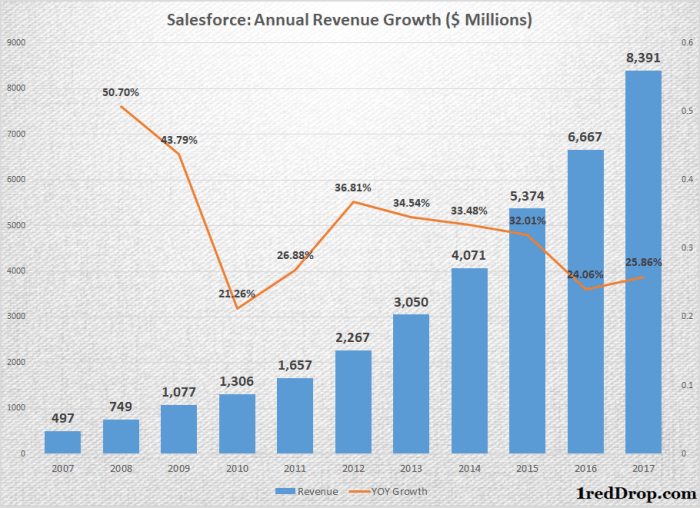
Annual revenue growth is a crucial metric for assessing a company’s financial health and performance over time. It represents the percentage change in a company’s revenue from one year to the next, providing insights into its ability to generate sales and expand its market share. Understanding this growth is vital for investors, stakeholders, and management in making informed decisions about the company’s future.Understanding annual revenue growth allows businesses to track their progress, identify trends, and make necessary adjustments to their strategies.
High growth indicates strong performance and potential for future success, while low or negative growth signals potential problems requiring immediate attention. This metric helps businesses benchmark their performance against competitors and industry averages, offering a clear picture of their position within the market.
Methods for Calculating Annual Revenue Growth
Several methods exist for calculating annual revenue growth, each offering a slightly different perspective on the data. The choice of method depends on the specific needs and context of the analysis. The most common methods include year-over-year (YoY) growth and compound annual growth rate (CAGR).Year-over-year growth simply compares the revenue of one year to the revenue of the previous year.
This provides a straightforward snapshot of growth for a specific period. The formula is: (Current Year Revenue - Previous Year Revenue) / Previous Year Revenue100%. For example, if a company’s revenue was $1 million in 2022 and $1.2 million in 2023, the YoY growth would be 20%.Compound annual growth rate (CAGR) provides a smoothed-out average annual growth rate over a longer period. This is particularly useful when analyzing growth over multiple years, as it accounts for the compounding effect of growth over time.
The formula is more complex: [(Ending Value / Beginning Value)^(1 / Number of Years)]
- 1
- 100%. For example, if a company’s revenue grew from $1 million in 2020 to $1.5 million in 2023, the CAGR would be approximately 14.47%. CAGR provides a more consistent view of long-term growth trends, smoothing out year-to-year fluctuations.
Hypothetical Scenarios Illustrating Annual Revenue Growth
Consider two hypothetical companies, Company A and Company B, both operating in the same industry. Company A experiences consistent high annual revenue growth of 20% per year for five years. This signifies strong market demand for its products or services, effective marketing strategies, and perhaps a first-mover advantage. Over five years, Company A would see substantial revenue expansion, potentially attracting significant investment and expanding its market share rapidly.
However, sustaining this high growth rate indefinitely is challenging and often unsustainable in the long run.In contrast, Company B experiences low and fluctuating annual revenue growth, averaging only 5% per year over the same five-year period. This could indicate several factors, including increased competition, a saturated market, or ineffective business strategies. While Company B is still growing, its slower pace might limit its expansion potential and attract less investment compared to Company A.
This necessitates a thorough review of its business model and operational efficiency to improve its growth trajectory. Company B might need to innovate, diversify its product offerings, or target new markets to enhance its revenue growth.
Factors Influencing Annual Revenue Growth
Annual revenue growth is a crucial indicator of a company’s financial health and overall success. Understanding the factors that drive—or hinder—this growth is essential for effective strategic planning and decision-making. This section will explore both internal and external influences on annual revenue growth, highlighting their relative importance and providing examples of their impact.
Internal Factors Influencing Revenue Growth
Internal factors are those directly controlled by the company. These range from innovative product development to streamlined operational efficiency. Positive internal factors contribute significantly to increased revenue, while neglecting them can lead to stagnation or decline.Product innovation is a primary driver. Developing new products or significantly improving existing ones can capture new market segments and increase customer loyalty.
For example, Apple’s consistent introduction of innovative iPhones and other devices has fueled its remarkable revenue growth over the years. Efficient operations, including optimized supply chains and lean manufacturing processes, directly impact profitability and allow for competitive pricing, thereby enhancing revenue generation. A company that streamlines its processes and reduces waste can reinvest savings in marketing or research and development, further boosting revenue.
Strong leadership and a skilled workforce also contribute significantly. A well-structured organizational chart, efficient communication, and clear roles and responsibilities all help contribute to a smoothly functioning business, improving productivity and overall financial results.
External Factors Influencing Revenue Growth
External factors, conversely, are largely beyond a company’s direct control. These factors can significantly impact revenue growth, creating both opportunities and challenges. Understanding and adapting to these external forces is critical for sustainable growth.Economic conditions, such as recession or expansion, play a major role. During economic downturns, consumer spending typically decreases, negatively affecting revenue for many businesses.
Conversely, periods of economic growth usually translate into increased consumer spending and higher revenue for businesses. Market competition is another powerful force. Intense competition can pressure pricing and reduce profit margins, impacting revenue growth. Conversely, a less competitive market allows for higher pricing and greater market share. Government regulations and policies can also influence revenue growth, impacting various aspects of business operations.
For example, new environmental regulations may increase operating costs, while tax incentives can boost profitability. Changes in consumer preferences and technological advancements are equally significant. Companies that fail to adapt to shifting consumer demands or technological disruptions risk losing market share and revenue.
The Interplay of Marketing Strategies and Sales Performance
Marketing strategies and sales performance are intrinsically linked to revenue growth. Effective marketing campaigns generate leads and build brand awareness, laying the foundation for sales. Strong sales performance, in turn, converts those leads into actual sales, directly impacting revenue. The effectiveness of marketing strategies can be measured by metrics such as website traffic, lead generation, and brand awareness, while sales performance is typically assessed through sales figures, conversion rates, and customer acquisition costs.
A well-coordinated marketing and sales team can significantly amplify the impact on revenue growth. For instance, a targeted social media campaign combined with a highly effective sales team can dramatically increase sales conversions. Conversely, poor marketing or weak sales performance can significantly hinder revenue growth, regardless of other positive factors.
Factors Affecting Annual Revenue Growth: A Comparative Table
| Factor Type | Factor Description | Positive Impact | Negative Impact |
|---|---|---|---|
| Internal | Product Innovation | Increased market share, higher prices, new customer segments | High R&D costs, product failure, market saturation |
| Internal | Efficient Operations | Reduced costs, increased profitability, competitive pricing | High initial investment, potential for operational disruptions |
| External | Economic Conditions | Increased consumer spending, higher demand | Reduced consumer spending, lower demand, economic uncertainty |
| External | Market Competition | Opportunities for differentiation, innovation | Price wars, reduced profit margins, loss of market share |
| Internal/External | Marketing & Sales | Increased brand awareness, higher conversion rates, stronger customer relationships | Ineffective campaigns, poor sales performance, lack of customer engagement |
Analyzing Revenue Growth Trends
Understanding the patterns and fluctuations in annual revenue growth is crucial for effective business planning and decision-making. Analyzing these trends allows businesses to identify periods of strong performance, pinpoint potential weaknesses, and make data-driven predictions for future growth. This analysis provides a foundation for strategic adjustments and resource allocation.Analyzing revenue growth involves examining historical data to identify trends, predict future performance, and inform strategic decisions.
Several methods can be employed to achieve this, including the use of visual representations and statistical forecasting techniques.
Visualizing Revenue Growth Trends
Visual representations of revenue growth data, such as line graphs and bar charts, are effective tools for identifying trends. A line graph, for instance, clearly shows the progression of revenue over time, highlighting periods of growth, decline, or stagnation. A bar chart can be used to compare revenue across different time periods or product categories. By visually representing the data, key patterns become readily apparent, making it easier to identify upward or downward trends, seasonal variations, and the impact of specific events or initiatives.
For example, a line graph depicting a steady upward slope indicates consistent growth, while a graph showing sharp peaks and valleys might indicate significant seasonality or market volatility.
Predicting Future Revenue Growth Using Historical Data
Historical revenue data provides a valuable foundation for predicting future growth. Simple methods, like calculating the average annual growth rate over a specific period, can offer a baseline prediction. More sophisticated techniques, such as linear regression or time series analysis, can account for more complex patterns and produce more accurate forecasts. For example, if a company has experienced an average annual growth rate of 10% over the past five years, a simple prediction would suggest a similar growth rate in the coming year.
However, external factors and internal changes should be considered for a more nuanced forecast. A company might use a time series model to account for seasonality, such as higher sales during the holiday season, which a simple average wouldn’t capture.
Interpreting Revenue Growth Trends: A Hypothetical Scenario
Let’s consider a hypothetical scenario for “ABC Company.” Over the past five years, ABC Company’s annual revenue has been: Year 1: $1 million; Year 2: $1.2 million; Year 3: $1.4 million; Year 4: $1.5 million; Year 5: $1.3 million. A line graph would show a steady increase for the first three years, followed by a slight increase in Year 4 and a decrease in Year 5.
This decrease warrants investigation. Further analysis might reveal that a new competitor entered the market in Year 5, impacting ABC Company’s sales. This insight would inform business decisions, such as investing in a new marketing campaign or developing a new product to regain market share.
Steps in Analyzing Revenue Growth Trends
Analyzing revenue growth trends involves a systematic approach. The following steps Artikel a practical framework:
- Gather Data: Collect historical revenue data, ensuring accuracy and completeness.
- Visualize Data: Create charts and graphs (line graphs, bar charts) to represent the data visually.
- Identify Trends: Analyze the visual representations to identify patterns of growth, decline, or stagnation.
- Analyze Contributing Factors: Investigate the factors that may have influenced the observed trends (e.g., market conditions, company initiatives).
- Develop Predictions: Use appropriate forecasting methods (e.g., average growth rate, regression analysis) to predict future revenue growth.
- Inform Decisions: Use the analysis and predictions to inform strategic decisions regarding marketing, product development, and resource allocation.
Strategies for Improving Revenue Growth
Boosting annual revenue requires a strategic approach that goes beyond simply hoping for increased sales. It necessitates a proactive plan encompassing various avenues for growth, coupled with meticulous monitoring and adaptation. Successful revenue growth strategies leverage a combination of market expansion, product innovation, and operational efficiencies.
Several key strategies can significantly accelerate revenue growth. These strategies often work best in concert, creating a synergistic effect. Focusing on a single approach may yield limited results, while a multi-pronged strategy offers a more robust and resilient path to achieving ambitious revenue targets.
Expanding into New Markets
Expanding into new markets presents significant opportunities for revenue growth. This can involve targeting geographically distinct regions, exploring new customer segments within existing markets, or even venturing into entirely new industries. For example, a company specializing in organic skincare could expand geographically from a solely domestic market to international markets like Europe or Asia, tapping into new consumer bases with similar preferences.
Alternatively, they could expand into a new customer segment, targeting men instead of solely focusing on women. Thorough market research is crucial before expanding, ensuring the chosen market aligns with the company’s capabilities and possesses sufficient demand for its products or services. This involves analyzing market size, competitive landscape, cultural nuances, and regulatory environments.
Developing New Products and Services
Developing new products or services allows companies to cater to evolving customer needs and preferences, thereby generating new revenue streams. This could involve creating entirely new offerings or enhancing existing ones with additional features or functionalities. For example, a software company might develop a mobile application version of its existing desktop software, expanding its reach to a wider audience.
A food company might introduce a new line of healthy snacks to capitalize on growing consumer demand for healthier food options. The development process should be guided by thorough market research and a deep understanding of customer needs, ensuring the new products resonate with the target market and offer a competitive advantage.
Implementing a Detailed Revenue Growth Strategy: Example – Product Diversification
Let’s Artikel a plan for implementing a product diversification strategy:
- Market Research and Analysis: Conduct thorough research to identify unmet customer needs and potential new product opportunities. Analyze market trends, competitor offerings, and customer feedback.
- Product Development: Develop a prototype of the new product, focusing on features and functionality that address identified customer needs. This may involve internal development or collaboration with external partners.
- Testing and Refinement: Conduct rigorous testing and gather feedback from target customers to refine the product and ensure it meets their expectations. This iterative process helps to minimize potential risks and maximize the chances of success.
- Marketing and Launch: Develop a comprehensive marketing plan to promote the new product and reach the target audience. This could involve online marketing, public relations, and sales promotions.
- Monitoring and Evaluation: Continuously monitor the performance of the new product, tracking key metrics such as sales, customer satisfaction, and market share. Use this data to make adjustments and optimize the product and marketing strategies.
Measuring the Effectiveness of Revenue Growth Strategies
Measuring the effectiveness of revenue growth strategies is essential for determining their success and making necessary adjustments. Key performance indicators (KPIs) should be established before implementing any strategy. These KPIs could include:
- Revenue Growth Rate: The percentage increase in revenue over a specific period. A consistent increase indicates successful implementation.
- Customer Acquisition Cost (CAC): The cost of acquiring a new customer. Lower CAC suggests more efficient marketing and sales strategies.
- Customer Lifetime Value (CLTV): The total revenue generated by a customer over their relationship with the company. Higher CLTV indicates strong customer retention and loyalty.
- Market Share: The percentage of the total market that a company controls. An increase in market share indicates successful competition and growth.
Regularly tracking these KPIs allows for data-driven decision-making, enabling adjustments to strategies as needed. For instance, if the CAC is too high, the marketing strategy may need to be revised. Conversely, a consistently increasing CLTV signals successful customer retention efforts.
Potential Challenges and Solutions
Implementing revenue growth strategies often presents challenges. Proactive planning and mitigation strategies are vital.
- Challenge: Insufficient funding for new product development or market expansion. Solution: Explore funding options such as venture capital, angel investors, or bank loans. Prioritize projects based on potential return on investment (ROI).
- Challenge: Intense competition in the target market. Solution: Develop a unique value proposition that differentiates the company’s offerings from competitors. Focus on building strong brand recognition and customer loyalty.
- Challenge: Difficulty in reaching the target market. Solution: Utilize a multi-channel marketing approach, leveraging both online and offline channels. Invest in market research to better understand the target audience.
- Challenge: Lack of internal expertise or resources. Solution: Hire skilled personnel or outsource specific tasks to external consultants or agencies. Invest in employee training and development.
Revenue Growth and its Relation to other Key Metrics
Understanding revenue growth in isolation provides an incomplete picture of a company’s financial health. A holistic view requires examining its relationship with other key performance indicators (KPIs), revealing a more nuanced understanding of overall business performance and sustainability. This section explores the interconnectedness of revenue growth with profitability, customer acquisition costs, and the impact on a company’s financial well-being.Revenue growth’s relationship with profitability is paramount.
While increasing revenue is desirable, it’s meaningless without corresponding profitability.
Revenue Growth and Profitability
Profitability, often measured by profit margins (gross profit margin, operating profit margin, net profit margin), directly reflects the efficiency of a company’s operations. High revenue growth without a simultaneous increase in profitability suggests potential issues, such as rising costs, inefficient pricing strategies, or inadequate cost controls. For example, a company might experience rapid sales growth by drastically reducing prices, leading to increased revenue but lower profit margins.
Conversely, sustainable growth ideally involves a balanced increase in both revenue and profit margins, indicating a healthy and efficient business model. Analyzing the relationship between revenue growth and various profit margin metrics provides critical insights into the sustainability and long-term viability of that growth. A consistent upward trend in both revenue and profit margins signals strong financial health.
Revenue Growth and Customer Acquisition Cost (CAC)
Customer acquisition cost (CAC) represents the total cost of acquiring a new customer. A high CAC relative to revenue growth indicates inefficiency in sales and marketing efforts. Companies need to carefully balance revenue growth with CAC to ensure that the cost of acquiring new customers doesn’t outweigh the revenue generated by those customers. For instance, a company with a high CAC might be employing ineffective marketing strategies, targeting the wrong customer segments, or facing excessive competition.
Conversely, a low CAC coupled with high revenue growth suggests a highly efficient customer acquisition process. A healthy business should strive to maintain a favorable ratio between CAC and customer lifetime value (CLTV).
Revenue Growth and Customer Lifetime Value (CLTV)
Customer lifetime value (CLTV) represents the total revenue a company expects to generate from a single customer throughout their relationship. High revenue growth often correlates with a high CLTV, suggesting the company is successfully retaining customers and generating repeat business. A low CLTV despite high revenue growth might indicate that the company is focusing too much on acquiring new customers and neglecting customer retention strategies.
Analyzing the CLTV alongside revenue growth allows businesses to assess the effectiveness of their customer relationship management (CRM) strategies and overall customer retention efforts. A high CLTV relative to CAC indicates a robust and sustainable business model.
Revenue Growth and Overall Financial Health
Revenue growth significantly impacts a company’s overall financial health. Increased revenue strengthens the company’s cash flow, providing resources for investments in research and development, expansion, and debt reduction. This positive cash flow improves the company’s creditworthiness and reduces financial risk. However, unsustainable revenue growth, particularly when accompanied by low profitability, can lead to financial instability. This might necessitate increased borrowing, which could negatively impact the company’s long-term financial health.
Ultimately, sustainable revenue growth, combined with strong profitability and efficient cost management, is crucial for a company’s long-term financial stability and success.
High Revenue Growth with Low Profitability: A Scenario
Imagine a rapidly expanding e-commerce company that prioritizes aggressive market share acquisition. To achieve rapid revenue growth, they engage in heavy discounting and promotional activities, leading to high sales volume. However, these deep discounts significantly compress profit margins, resulting in low profitability despite substantial revenue growth. The underlying reasons include: (1) Inefficient pricing strategies failing to account for costs; (2) High marketing and advertising expenses to drive sales; (3) Scaling challenges leading to increased operational costs.
While the high revenue might initially impress investors, the lack of profitability raises serious concerns about the company’s long-term viability. This scenario highlights the importance of balancing revenue growth with profitability to ensure sustainable business success.
Illustrating Revenue Growth
Visual representations are crucial for effectively communicating a company’s financial performance, particularly revenue growth. A well-designed chart can quickly convey complex data to stakeholders, facilitating informed decision-making and strategic planning. Using appropriate visuals allows for a clearer understanding of trends and patterns that might be missed when reviewing raw numerical data alone.A line graph is ideally suited to illustrate revenue growth over time.
For a five-year period, the horizontal axis would represent the years, while the vertical axis would show revenue figures (perhaps in millions or billions of dollars, depending on the company’s scale). Each data point would represent the company’s total revenue for a given year, connected by a line to show the trend.
Revenue Growth Graph: Key Features and Information Conveyed
The graph should clearly label both axes with appropriate units and a descriptive title, such as “Annual Revenue Growth, 2019-2023.” Different colors or patterns could highlight specific revenue streams if the company operates in multiple sectors. For instance, a solid line might represent core product sales, while a dashed line could depict revenue from new product launches. Key data points, such as years with exceptionally high or low growth, should be clearly marked and potentially annotated with brief explanations for significant changes.
For example, a sharp increase in 2021 might be attributed to successful marketing campaigns, while a dip in 2022 could be explained by supply chain disruptions.The graph should convey the overall trend of revenue growth (upward, downward, or stagnant). It should also highlight the rate of growth (e.g., consistently increasing, accelerating, decelerating) over the five-year period. Stakeholders would be particularly interested in identifying periods of significant change and understanding the underlying reasons.
This information allows them to assess the company’s financial health, the effectiveness of its strategies, and to anticipate future performance. For example, consistently high growth would signal strong market position and effective business practices, whereas periods of stagnation or decline would require further investigation into potential issues. The graph should provide a clear and concise visual summary of the company’s revenue performance, facilitating quick understanding and effective communication.
Revenue Growth
Understanding revenue growth requires a nuanced perspective, moving beyond simple year-over-year comparisons to delve into the underlying drivers and strategic implications. This deeper dive will explore the distinctions between organic and inorganic growth, the influence of diverse business models, and the application of forecasting models for future prediction.
Organic versus Inorganic Revenue Growth
Organic revenue growth stems from internal efforts, reflecting the inherent strength and appeal of a company’s products or services within its existing market. This growth is achieved through strategies such as enhanced marketing campaigns, product improvements, improved customer service, and expansion into new market segments within the company’s core competency. In contrast, inorganic revenue growth is driven by external factors, primarily through mergers, acquisitions, or strategic partnerships.
This type of growth is faster but can also be riskier, depending on the success of integration and the strategic fit of the acquired entity. For example, a software company experiencing organic growth might improve its user interface and add new features, attracting more customers and increasing subscription revenue. On the other hand, inorganic growth might involve acquiring a competitor, instantly expanding its market share and revenue base.
Business Model Impact on Revenue Growth
Different business models inherently influence revenue growth trajectories. Subscription-based models, for example, offer predictable recurring revenue but require a high initial customer acquisition cost and strong customer retention. Transaction-based models, on the other hand, rely on high sales volume and potentially shorter customer relationships. Freemium models combine free access with premium paid features, fostering user growth and converting a segment of users to paying customers.
A subscription SaaS (Software as a Service) company, like Salesforce, relies on consistent monthly or annual subscriptions for revenue growth. In contrast, an e-commerce business selling physical goods depends on a high volume of individual transactions and efficient logistics. A freemium model, such as Spotify, uses a free tier to attract users and then converts a portion to paid subscribers, leading to a gradual but potentially significant revenue increase.
Forecasting Revenue Growth
Predicting future revenue growth involves utilizing forecasting models that consider historical data, market trends, and anticipated changes. Simple linear regression can be used for straightforward projections, while more complex models, such as exponential smoothing or ARIMA (Autoregressive Integrated Moving Average), can capture non-linear trends and seasonality. For example, a company with consistent year-over-year growth might use linear regression to predict future revenue.
However, a company experiencing rapid growth due to a new product launch might need a more sophisticated model, like exponential smoothing, to account for the initial rapid growth followed by a potential stabilization. Accurate forecasting requires careful consideration of factors such as market size, competition, economic conditions, and the company’s own strategic initiatives. Furthermore, regularly reviewing and adjusting the forecasting model based on actual results is crucial for maintaining accuracy.
A crucial aspect is to understand the limitations of any model; forecasts are inherently uncertain and should be treated as probabilities rather than certainties.
Impact of Revenue Growth
Sustained revenue growth is a critical indicator of a company’s health and future prospects. It signifies not only an increase in sales but also reflects the company’s ability to attract and retain customers, innovate, and adapt to market changes. This growth has a profound impact on various aspects of the business, most notably its valuation and investor sentiment.Revenue growth significantly influences a company’s valuation, which is essentially the overall worth of the business.
Higher and consistent revenue growth generally translates to a higher valuation. Investors are willing to pay more for companies demonstrating a strong track record of increasing revenue, anticipating future profits and market dominance. This is often reflected in higher stock prices and increased market capitalization. Conversely, stagnant or declining revenue growth can significantly diminish a company’s valuation, signaling potential problems and making it less attractive to investors.
Revenue Growth and Company Valuation
A company’s valuation is often determined using various methods, including discounted cash flow analysis and comparable company analysis. In both cases, revenue growth plays a pivotal role. Higher revenue growth projections lead to higher estimated future cash flows, which in turn result in a higher valuation under discounted cash flow analysis. Similarly, in comparable company analysis, companies with stronger revenue growth command higher valuation multiples compared to their peers with slower growth.
For instance, a technology company consistently exceeding its revenue targets might trade at a significantly higher price-to-earnings (P/E) ratio than a competitor experiencing slower growth, even if their current earnings are similar.
Revenue Growth’s Effect on Investor Confidence and Stock Price
Strong and consistent revenue growth is a key driver of investor confidence. Investors see it as a sign of a healthy and expanding business, indicating the company’s ability to execute its strategy, capture market share, and generate profits. This positive sentiment translates into increased demand for the company’s stock, leading to a higher stock price. Conversely, declining revenue growth can severely erode investor confidence, leading to sell-offs and a decline in the stock price.
The news of a significant revenue shortfall can trigger a rapid and substantial drop in the stock price, reflecting investors’ concerns about the company’s future prospects and profitability. For example, a sudden drop in sales for a retail giant due to changing consumer preferences might lead to a significant decline in its stock price, impacting investor portfolios and the overall market sentiment.
Implications of Declining Revenue Growth for Long-Term Sustainability
Declining revenue growth, if sustained, can have severe implications for a company’s long-term sustainability. It can indicate underlying problems such as increased competition, changing market dynamics, or internal operational inefficiencies. Without addressing the root causes of declining revenue, a company may struggle to maintain profitability, invest in research and development, or attract and retain talent. This can lead to a vicious cycle, where declining revenue further hampers the company’s ability to compete effectively, ultimately threatening its survival.
A classic example would be a brick-and-mortar retailer failing to adapt to the rise of e-commerce; the lack of revenue growth in the physical stores eventually leads to store closures, job losses, and potentially bankruptcy.
Successfully navigating the complexities of annual revenue growth requires a holistic approach, combining astute analysis of past performance with strategic planning for the future. By understanding the interplay of internal and external factors, employing effective growth strategies, and consistently monitoring key metrics, businesses can achieve sustainable revenue growth and build a strong foundation for long-term success. Remember that consistent monitoring and adaptation are key to maintaining a healthy trajectory.
Commonly Asked Questions
What is the difference between organic and inorganic revenue growth?
Organic growth stems from internal efforts like improved marketing or product development. Inorganic growth comes from external sources like mergers or acquisitions.
How can I accurately predict future revenue growth?
Use forecasting models that consider historical data, market trends, and planned initiatives. No prediction is perfect, but robust models improve accuracy.
What are some common pitfalls in pursuing revenue growth?
Common pitfalls include neglecting customer retention, focusing solely on short-term gains, and failing to adapt to changing market conditions.
How does revenue growth impact a company’s valuation?
Sustained revenue growth significantly increases a company’s valuation as it signals stability and future potential to investors.