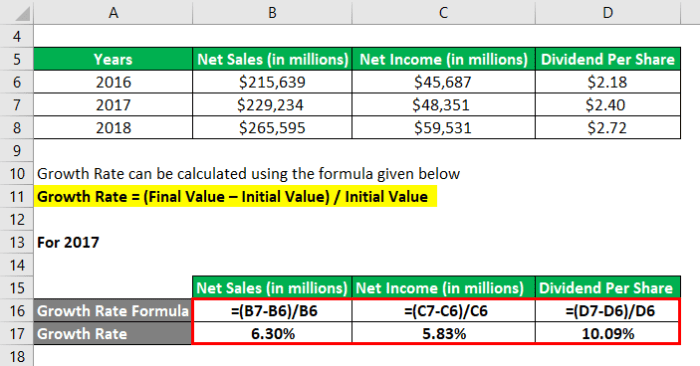
Understanding revenue growth is crucial for any business aiming for sustainable success. This guide delves into the mechanics of calculating revenue growth rates, exploring various methods and factors that influence this key performance indicator. We’ll examine different calculator types, interpret results effectively, and discuss strategies for optimizing growth.
From simple year-over-year comparisons to more complex compound calculations, we’ll equip you with the knowledge to accurately assess your business’s financial health and make informed decisions for the future. We will also cover the importance of considering both internal and external factors influencing growth, and how to develop realistic long-term projections.
Factors Affecting Revenue Growth Rate
Understanding the factors influencing a company’s revenue growth rate is crucial for accurate forecasting and strategic planning. Revenue growth isn’t simply a matter of chance; it’s a complex interplay of internal actions and external market forces. By analyzing these factors, businesses can better anticipate future performance and make informed decisions to enhance their revenue trajectory.
Internal Factors Influencing Revenue Growth
Internal factors are those directly under a company’s control. Effective management of these factors can significantly impact revenue growth. These range from pricing strategies and product development to marketing and sales effectiveness.
| Factor Type | Factor Name | Positive Impact | Negative Impact |
|---|---|---|---|
| Pricing | Pricing Strategies | Premium pricing can increase perceived value and profitability. Value-based pricing can attract customers willing to pay more for superior quality. | Overly high prices can deter customers. Price wars can erode profit margins. Inflexible pricing strategies may fail to adapt to market changes. |
| Marketing & Sales | Marketing Campaigns | Effective advertising and targeted marketing campaigns can significantly increase brand awareness and sales. Successful sales strategies can boost conversion rates. | Poorly executed campaigns waste resources. Ineffective sales training can lead to lost opportunities. A lack of brand awareness can hinder market penetration. |
| Product Development | New Product Launches | Introducing innovative products or expanding product lines can attract new customers and increase sales volume. | Product failures can damage brand reputation and lead to financial losses. Poor product-market fit can result in low sales. |
| Operations | Operational Efficiency | Streamlined operations reduce costs, allowing for lower prices or higher profit margins. Improved efficiency can lead to faster order fulfillment and increased customer satisfaction. | Inefficient processes increase costs and reduce profitability. Supply chain disruptions can lead to production delays and lost sales. |
External Factors Influencing Revenue Growth
External factors are those outside a company’s direct control, but which nonetheless significantly influence its revenue growth. These factors often require proactive adaptation and strategic planning to mitigate potential negative impacts.
| Factor Type | Factor Name | Positive Impact | Negative Impact |
|---|---|---|---|
| Economic Conditions | Economic Growth | Strong economic growth typically leads to increased consumer spending and higher demand for goods and services. | Recessions or economic downturns reduce consumer spending and can severely impact revenue. |
| Competition | Competitive Landscape | A less competitive market allows for higher pricing and greater market share. Innovation can create a competitive advantage. | Intense competition can lead to price wars and reduced profit margins. New entrants can disrupt the market. |
| Regulatory Environment | Government Regulations | Favorable regulations can stimulate growth and reduce barriers to entry. | Unfavorable regulations can increase costs and restrict business operations. |
| Technological Advancements | Technological Disruption | New technologies can create opportunities for innovation and efficiency gains. | Rapid technological change can render existing products obsolete and require significant investment in adaptation. |
Incorporating Factors into Revenue Growth Projections
To create a realistic revenue growth projection, businesses must consider both internal and external factors. For example, a company projecting growth might estimate a 10% increase based on successful marketing campaigns (internal factor) but adjust this downward to 7% to account for a potential economic slowdown (external factor). This involves qualitative assessment of the likelihood and impact of each factor, often combined with quantitative data where available.
For instance, past sales data can inform projections of marketing campaign effectiveness, while economic forecasts can provide insights into potential market conditions. The more accurately these factors are considered, the more reliable the revenue projection will be.
Revenue Growth Strategies
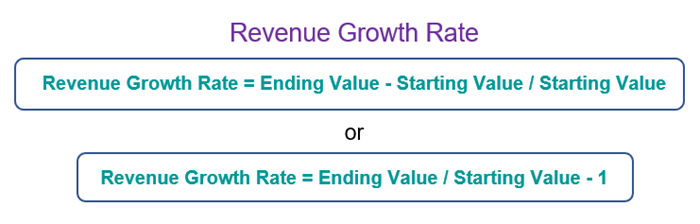
Boosting revenue requires a multifaceted approach, encompassing strategies to increase sales volume, optimize pricing, expand market reach, and introduce new products or services. Successful implementation hinges on thorough market research and a keen understanding of the competitive landscape. This section details various strategies and their application.
Increasing Sales Volume
Strategies focused on increasing sales volume aim to sell more of your existing products or services to your current customer base or attract new customers. This can be achieved through several methods, including enhanced marketing campaigns, improved customer service leading to increased loyalty and repeat business, and strategic partnerships to expand your reach. For example, a company could launch a targeted social media campaign to reach a wider audience or implement a loyalty program to incentivize repeat purchases.
Another approach is to optimize the sales process itself, streamlining it to make it easier for customers to purchase.
Optimizing Pricing Strategies
Pricing strategies significantly impact revenue. A well-defined pricing strategy considers factors such as cost of goods sold, competitor pricing, and customer perceived value. Options include value-based pricing, where prices reflect the perceived value to the customer, and cost-plus pricing, where a markup is added to the cost of production. For instance, a luxury goods company might employ value-based pricing, while a manufacturer of everyday items might utilize cost-plus pricing.
Dynamic pricing, adjusting prices based on demand and other market factors, is another increasingly popular strategy. For example, an airline might adjust ticket prices based on seat availability and time until departure.
Expanding into New Markets
Expanding into new markets involves identifying and targeting new customer segments or geographical areas. This could involve international expansion, targeting a niche market within your existing geographic area, or focusing on a new demographic. Thorough market research is crucial to assess the viability and potential of each new market. For example, a company selling organic food products might expand into a new region with a growing demand for healthy food options, or a software company might target a new industry vertical with specific needs that its software can address.
Successful expansion requires careful consideration of cultural nuances, regulatory environments, and competitive landscapes in the new market.
Introducing New Product Lines
Diversification through new product lines reduces reliance on a single product or service and can open up new revenue streams. This requires careful consideration of market demand, production capabilities, and potential competition. A successful example would be a company that initially produced only clothing expanding into accessories or footwear, leveraging its existing brand recognition and customer base. Alternatively, a company could develop complementary products or services that enhance the value proposition of its existing offerings.
For instance, a software company might develop training materials or support services to complement its core software product.
The Importance of Market Research and Competitive Analysis
Effective revenue growth planning necessitates comprehensive market research and competitive analysis. Market research identifies target audiences, their needs, and preferences, informing product development and marketing strategies. Competitive analysis reveals the strengths and weaknesses of competitors, guiding strategic positioning and differentiation. For example, analyzing competitor pricing, marketing campaigns, and customer reviews can provide valuable insights for developing a more effective revenue growth strategy.
This data-driven approach reduces risk and increases the likelihood of success.
Implementing a Revenue Growth Strategy: A Flowchart
The following flowchart illustrates the steps involved in implementing a revenue growth strategy. Imagine a flowchart with boxes and arrows. The first box would be “Define Objectives,” leading to “Conduct Market Research.” This would then branch into “Competitive Analysis” and “Identify Target Market.” These would then converge into “Develop Strategies” (e.g., increase sales volume, optimize pricing, expand into new markets, introduce new products).
Next would be “Implement Strategies,” followed by “Monitor and Evaluate Results.” Finally, the flowchart would end with “Adjust Strategy as Needed,” looping back to “Monitor and Evaluate Results.” This cyclical process ensures continuous improvement and adaptation to changing market conditions.
REVENUE GROWTH
Long-term revenue growth projections are essential for the strategic planning and financial health of any business. They provide a roadmap for future performance, allowing businesses to make informed decisions about investments, resource allocation, and overall business strategy. Without a clear understanding of potential future revenue, companies risk misallocating resources and missing opportunities for growth.
Importance of Long-Term Revenue Growth Projections
Accurate long-term revenue projections are crucial for several reasons. They inform investment decisions, allowing businesses to secure funding based on realistic expectations. They also guide resource allocation, helping companies optimize staffing, marketing, and operational budgets. Furthermore, these projections facilitate strategic planning, enabling businesses to anticipate market shifts and adapt their strategies accordingly. Finally, they enhance credibility with stakeholders, including investors, lenders, and potential partners, demonstrating a clear understanding of the business’s trajectory.
Methods for Creating Realistic Long-Term Revenue Growth Projections
Several methods contribute to the creation of realistic long-term revenue growth projections. Historical data analysis, examining past revenue trends to identify patterns and growth rates, forms a strong foundation. Market research, involving studying industry trends, competitor analysis, and market size estimations, provides crucial external context. Sales forecasting, utilizing various techniques like moving averages or exponential smoothing, predicts future sales based on historical and current data.
Scenario planning, exploring different potential future scenarios (e.g., optimistic, pessimistic, most likely), allows for flexibility and preparedness. Finally, incorporating expert opinions from industry professionals and internal teams provides valuable insights and mitigates potential biases.
Scenarios Requiring Accurate Long-Term Projections
Accurate long-term projections are especially vital in scenarios such as securing significant funding rounds from venture capitalists or private equity firms. Investors rely heavily on these projections to assess the potential return on their investment. Similarly, planning for major capital expenditures, such as building a new factory or acquiring another company, requires accurate revenue projections to justify the investment.
Furthermore, strategic partnerships and mergers and acquisitions often hinge on realistic long-term revenue forecasts to demonstrate synergy and long-term value creation. Finally, long-term financial planning, including debt management and dividend payouts, needs reliable revenue projections to ensure financial stability and sustainability.
Forecasting Models and Assumptions in Revenue Growth Projections
Forecasting models, such as linear regression, exponential growth, or more complex time series models, are used to project future revenue. However, these models rely heavily on assumptions about various factors, including market growth rates, pricing strategies, and the impact of new products or services. These assumptions should be clearly stated and justified, acknowledging inherent uncertainties. Sensitivity analysis, examining how changes in key assumptions affect the projected revenue, helps to assess the robustness of the projections.
For instance, a company might assume a 5% annual market growth rate, but conduct sensitivity analysis by exploring scenarios with 3% and 7% growth to understand the range of possible outcomes.
Simple Revenue Projection Table
The following table demonstrates a simple revenue projection for the next five years, assuming a consistent 10% annual growth rate. Note that this is a simplified example and real-world projections would incorporate more sophisticated modeling and a wider range of assumptions.
| Year | Projected Revenue |
|---|---|
| Year 1 | $1,100,000 |
| Year 2 | $1,210,000 |
| Year 3 | $1,331,000 |
| Year 4 | $1,464,100 |
| Year 5 | $1,610,510 |
Mastering revenue growth rate calculations is not just about crunching numbers; it’s about gaining a profound understanding of your business’s trajectory. By utilizing the techniques and strategies Artikeld in this guide, you can effectively monitor progress, identify areas for improvement, and formulate effective plans to achieve your financial goals. Proactive analysis and strategic planning, based on accurate growth rate calculations, pave the way for sustained business prosperity.
Common Queries
What is the difference between simple and compound revenue growth rates?
Simple growth rate calculates growth based on the initial revenue only, while compound growth accounts for the accumulated growth over time, reflecting reinvestment of earnings.
How often should I calculate my revenue growth rate?
Frequency depends on your business needs. Monthly, quarterly, and yearly calculations offer different perspectives; more frequent calculations provide a more granular view of performance.
What if my revenue growth rate is negative?
A negative growth rate indicates a decline in revenue. Analyze contributing factors (market conditions, internal issues) and implement corrective strategies to reverse the trend.
Can I use this calculator for different time periods (e.g., 5 years, 10 years)?
Yes, the fundamental principles apply to any time period. However, longer periods may require adjustments for inflation and other macroeconomic factors.


