
Understanding revenue growth is paramount for any business aiming for sustainable success. This guide delves into the critical Key Performance Indicators (KPIs) that provide a clear picture of your financial health and growth trajectory. We’ll explore how to select the right KPIs, analyze trends, identify growth drivers, and implement effective strategies to boost your bottom line.
From analyzing year-over-year growth to identifying the impact of factors like average transaction value and customer retention, we’ll equip you with the knowledge and tools to make data-driven decisions. We’ll also examine how revenue growth interacts with other crucial business metrics, ensuring a balanced and sustainable approach to expansion.
Defining Revenue Growth KPIs
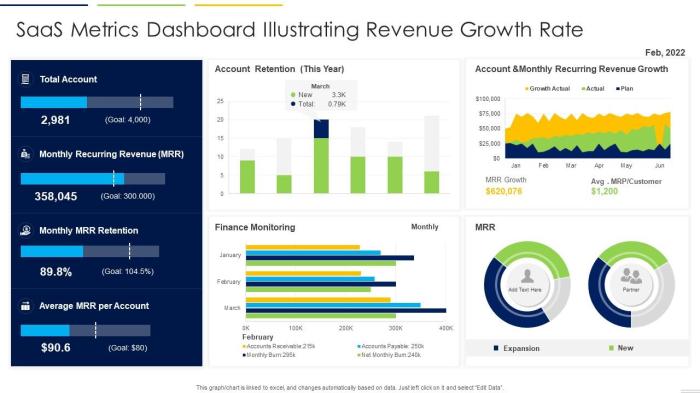
Understanding and tracking key performance indicators (KPIs) is crucial for any business aiming for sustainable revenue growth. These metrics provide quantifiable insights into various aspects of the business, allowing for data-driven decision-making and strategic adjustments. By monitoring the right KPIs, companies can identify areas of strength, pinpoint weaknesses, and ultimately optimize their revenue generation strategies.Choosing the appropriate KPIs is not a one-size-fits-all process.
The ideal selection depends heavily on the specific goals of the business, its current stage of development, and the competitive landscape of its industry. A startup focusing on rapid market penetration will prioritize different KPIs than an established enterprise aiming for market share consolidation. Benchmarking against industry averages provides further context and helps identify areas for improvement or potential risks.
Revenue Growth KPI Examples
The following table Artikels several common KPIs used to measure revenue growth. Each KPI offers a unique perspective on different facets of the revenue generation process, providing a holistic view of the business’s performance.
| KPI Name | Definition | Calculation Method | Example |
|---|---|---|---|
| Year-over-Year (YoY) Revenue Growth | Measures the percentage change in revenue compared to the same period in the previous year. | [(Current Year Revenue – Previous Year Revenue) / Previous Year Revenue] – 100 | If revenue was $1 million last year and $1.2 million this year, the YoY growth is 20%. |
| Month-over-Month (MoM) Revenue Growth | Measures the percentage change in revenue compared to the previous month. | [(Current Month Revenue – Previous Month Revenue) / Previous Month Revenue] – 100 | If revenue was $100,000 last month and $110,000 this month, the MoM growth is 10%. |
| Average Revenue Per User (ARPU) | Measures the average revenue generated per user over a specific period. | Total Revenue / Number of Users | If a company generated $100,000 in revenue with 1,000 users, the ARPU is $100. |
| Customer Lifetime Value (CLTV) | Predicts the total revenue a company expects to generate from a single customer throughout their relationship. | Average Purchase Value
|
A customer with an average purchase value of $50, purchasing 4 times a year for 5 years, has a CLTV of $1000. |
| Customer Acquisition Cost (CAC) | Measures the cost of acquiring a new customer. | Total Marketing and Sales Costs / Number of New Customers Acquired | If a company spent $10,000 on marketing and acquired 100 new customers, the CAC is $100. |
| Conversion Rate | Measures the percentage of website visitors or leads who complete a desired action (e.g., purchase, signup). | (Number of Conversions / Number of Website Visitors or Leads) – 100 | If 1000 visitors resulted in 100 sales, the conversion rate is 10%. |
Illustrative Scenario: Divergent KPI Perspectives
Imagine a SaaS company launching a new feature. While MoM revenue growth might show a significant increase due to initial excitement and adoption, ARPU might remain relatively flat or even decrease if the new feature is offered at a lower price point. Simultaneously, CAC might increase due to increased marketing spend to promote the new feature. This scenario highlights how different KPIs can paint a complex picture of revenue growth, emphasizing the importance of considering multiple metrics to understand the complete story.
A solely positive MoM growth might mask underlying issues with profitability if the CAC increase significantly outpaces the revenue increase.
Analyzing Revenue Growth Trends
Understanding how your revenue is changing over time is crucial for informed business decisions. Analyzing revenue growth trends allows you to identify periods of strong performance, pinpoint areas needing improvement, and forecast future revenue. Several methods exist for analyzing this data, each offering unique insights.
Different methods provide varying perspectives on revenue growth. Choosing the right method depends on your specific needs and the timeframe you’re analyzing. Consider factors like business cycles, seasonal fluctuations, and the overall growth stage of your company when selecting an appropriate approach.
Methods for Analyzing Revenue Growth
Several key methods provide different perspectives on revenue growth. Each offers unique advantages and disadvantages, making the selection process crucial for accurate interpretation.
- Year-over-Year (YoY) Growth: This compares revenue for a given period to the same period in the previous year. For example, comparing October 2023 revenue to October 2022 revenue. This helps smooth out seasonal variations.
- Month-over-Month (MoM) Growth: This compares revenue for a given month to the previous month. For example, comparing September 2023 revenue to August 2023 revenue. This provides a more granular view of short-term trends, but can be more susceptible to noise.
- Compound Annual Growth Rate (CAGR): This represents the average annual growth rate of revenue over a specified period, assuming profits are reinvested during the period. It provides a smoothed, long-term perspective on growth. The formula for calculating CAGR is:
CAGR = [(Ending Value / Beginning Value)^(1 / Number of years)]
-1
Advantages and Disadvantages of Each Method
Each method offers unique advantages and disadvantages that must be carefully considered when analyzing revenue growth.
| Method | Advantages | Disadvantages |
|---|---|---|
| YoY Growth | Smooths out seasonal fluctuations, provides a clear year-on-year comparison. | Masks short-term trends, may not capture rapid changes. |
| MoM Growth | Highlights short-term trends, allows for quick identification of issues. | Highly susceptible to seasonal variations and noise, can be misleading without context. |
| CAGR | Provides a long-term perspective, useful for forecasting and strategic planning. | Ignores short-term fluctuations, may not reflect recent performance accurately. |
Visualizing Revenue Growth Trends
Visual representations significantly enhance the understanding and communication of revenue growth trends. Different chart types effectively represent different aspects of the data.
- Line Charts: Ideal for showing trends over time. A line chart effectively displays YoY, MoM, and CAGR data, allowing for easy comparison of growth rates across different periods. For example, a line chart could display monthly revenue over a year, clearly showing peaks and valleys in sales.
- Bar Charts: Useful for comparing revenue across different categories or time periods. A bar chart could compare quarterly revenue for several years, highlighting variations between quarters and yearly growth.
- Area Charts: Similar to line charts, but the area under the line is filled, making it easier to visualize the cumulative revenue over time. This is particularly useful for showing the overall growth trajectory.
Identifying Drivers of Revenue Growth
Understanding the factors that drive revenue growth is crucial for businesses aiming for sustainable expansion. This involves analyzing both internal operational elements and external market influences to pinpoint areas for strategic improvement and capitalize on opportunities. A multi-faceted approach, encompassing sales volume, pricing strategies, and customer loyalty, is often necessary for achieving significant and consistent revenue increases.Revenue growth, at its core, is the increase in a company’s sales over a specified period.
Several key factors contribute to this increase, creating a complex interplay of internal strategies and external market forces. Analyzing these drivers allows businesses to focus their efforts effectively and predict future performance more accurately.
Key Internal Drivers of Revenue Growth
Increased sales volume, higher average transaction value (ATV), and improved customer retention are fundamental internal factors driving revenue growth. These elements are interconnected and often influence each other. For example, improved customer retention can lead to increased sales volume through repeat purchases and positive word-of-mouth referrals. Similarly, a higher ATV can contribute to increased overall revenue even if sales volume remains relatively stable.
The Interplay of Revenue Growth Drivers
The following flowchart illustrates the relationship between these key factors and overall revenue growth:[Imagine a flowchart here. The flowchart would start with three boxes representing “Increased Sales Volume,” “Higher Average Transaction Value (ATV),” and “Improved Customer Retention.” Arrows would point from each of these boxes to a central box labeled “Overall Revenue Growth.” Smaller arrows could also connect the three initial boxes to show potential interdependencies.
For example, an arrow could connect “Improved Customer Retention” to “Increased Sales Volume” to represent repeat purchases.]
External Factors Influencing Revenue Growth
External factors significantly impact a company’s revenue growth trajectory. Market trends, such as the increasing popularity of a particular product category or a shift in consumer preferences, can create new opportunities or necessitate adjustments to existing strategies. Economic conditions, including inflation, recession, or periods of economic expansion, also play a crucial role. For instance, during an economic downturn, consumers may reduce spending, leading to lower sales volume for many businesses.
Conversely, during periods of economic growth, increased consumer spending can significantly boost revenue. Changes in government regulations or policies can also affect a company’s revenue, impacting market access or operational costs.
Examples of External Factor Influence
Consider the impact of the rise of e-commerce on brick-and-mortar retailers. This market trend forced many businesses to adapt their strategies, investing in online platforms and adjusting their pricing models to compete effectively. Similarly, the COVID-19 pandemic significantly altered consumer behavior, leading to increased demand for certain goods and services while simultaneously disrupting supply chains and impacting the revenue of businesses across various sectors.
The subsequent economic recovery and inflationary pressures further complicated the landscape, highlighting the dynamic nature of external influences on revenue growth.
Strategies for Improving Revenue Growth
Boosting revenue requires a multifaceted approach, strategically combining internal improvements with external expansion. Understanding your current market position and identifying untapped potential are crucial first steps. This section Artikels effective strategies, tactical implementations, and measurable goals for achieving significant revenue growth.
Successful revenue growth hinges on a well-defined strategy that incorporates market analysis, product development, and customer engagement. Expanding into new markets, introducing innovative products or services, and optimizing the customer experience are key components of a robust revenue growth plan. This involves not only identifying opportunities but also executing a plan with measurable targets and regular monitoring.
Expanding into New Markets
Entering new markets offers significant potential for revenue expansion. Thorough market research is essential to identify suitable locations with high growth potential and minimal competitive pressure. This involves assessing demographic trends, economic indicators, and competitive landscapes to determine market viability. Successful market entry necessitates a tailored strategy, considering factors like cultural nuances, regulatory compliance, and logistical challenges. For example, a company selling organic food products might expand from a regional market to a larger national market by leveraging online sales channels and establishing strategic partnerships with national retailers.
This expansion requires careful planning to address potential logistical challenges such as transportation costs and inventory management in the new market.
Launching New Products or Services
Developing and launching new products or services can inject fresh revenue streams into a business. This requires a deep understanding of customer needs and market trends. Innovation is key, but so is aligning new offerings with the existing brand identity and customer base. For example, a software company might develop a new mobile app version of its existing desktop software, capitalizing on the growing mobile market.
This requires investment in app development, marketing, and customer support, but the potential return on investment can be substantial. Careful market research, including surveys and focus groups, is crucial in validating the demand for new offerings before committing significant resources to their development.
Enhancing Customer Experience
Improving customer experience directly impacts revenue growth. Satisfied customers are more likely to make repeat purchases and recommend the business to others. Strategies for enhancing customer experience include improving customer service, personalizing interactions, and implementing loyalty programs. For example, a retail company might implement a personalized email marketing campaign, recommending products based on customers’ past purchases. This can significantly increase customer engagement and boost sales.
Regularly monitoring customer feedback through surveys and reviews provides valuable insights for identifying areas for improvement and refining customer experience strategies.
Strategic Plan for Revenue Growth
The following table Artikels a sample strategic plan, illustrating the integration of strategies, tactics, timelines, and key metrics for improving revenue growth. This plan serves as a template and should be adapted to specific business contexts.
| Strategy | Tactics | Timeline | Key Metrics |
|---|---|---|---|
| Expand into New Markets (e.g., geographically) | Conduct market research, develop a targeted marketing campaign, establish partnerships with local distributors | 6-12 months | New customer acquisition rate, market share in new region, revenue generated from new market |
| Launch New Products/Services | Conduct market research, develop product prototypes, launch marketing campaign, secure funding | 9-18 months | Conversion rate, customer acquisition cost, customer lifetime value, revenue generated from new products/services |
| Enhance Customer Experience | Implement a customer relationship management (CRM) system, improve customer service training, launch loyalty program | 3-6 months | Customer satisfaction scores (CSAT), Net Promoter Score (NPS), customer churn rate, repeat purchase rate |
Utilizing Market Research for Revenue Growth Opportunities
Market research plays a vital role in identifying revenue growth opportunities. By systematically collecting and analyzing data, businesses can gain a comprehensive understanding of market trends, customer preferences, and competitive landscapes. This research can inform decisions regarding product development, market expansion, and pricing strategies. Qualitative research methods, such as focus groups and interviews, provide rich insights into customer motivations and preferences, while quantitative methods, such as surveys and data analysis, offer a broader perspective on market trends and demographics.
For example, conducting customer surveys can reveal unmet needs or preferences, leading to the development of new products or services that address these gaps. Analyzing competitor pricing strategies can inform optimal pricing decisions to maximize profitability.
Mastering revenue growth KPIs isn’t just about tracking numbers; it’s about understanding the narrative they tell. By effectively analyzing these indicators, identifying key drivers, and implementing strategic improvements, businesses can achieve sustainable growth and long-term success. This guide provides a framework for navigating the complexities of revenue growth, empowering you to make informed decisions and propel your business forward.
FAQ Resource
What if my revenue is growing, but my profit margins are shrinking?
This indicates a potential issue with cost management. While revenue growth is positive, analyze your expenses to identify areas for improvement and maintain profitability.
How often should I review my revenue growth KPIs?
Regular monitoring is crucial. Ideally, review your KPIs monthly to identify trends early and adjust strategies as needed. Quarterly and annual reviews provide longer-term perspective.
Which KPI is most important for a startup?
For startups, customer acquisition cost (CAC) and customer lifetime value (CLTV) are often paramount, as they reveal the efficiency of customer acquisition and long-term profitability.
How can I improve my average transaction value (ATV)?
Strategies include offering upsells and cross-sells, implementing tiered pricing, and bundling products or services.


